

(Discover many other contents on: NOWO.ONE and NOWO Publishing)
I remember the night my hallway light fixture started wobbling and all I had was a butter knife and stubborn optimism. That’s when I learned the value of a handful of reliable tools. In this post I walk you through a compact, sensible home toolkit that saved my sanity more than once — and how to build yours without becoming a hoarder of power tools.
Why a small toolkit matters (my accidental lesson)
My wobbling light fixture and the butter-knife moment
The first time I learned what a homeowner needs, I was standing under a wobbling light fixture with a butter knife in my hand. I’d noticed the shade was loose, and I figured, “How hard can it be?” Turns out, a butter knife is a terrible screwdriver. It slipped, scratched the screw, and nearly took a chunk out of my fingers. The light was still wobbling, and now I had a tiny mess to clean up.
That was the moment I stopped treating DIY essentials like a “someday” thing. I didn’t need a garage full of gear—I needed a small, reliable set of essential tools that could handle real-life fixes without drama.
Fewer, better tools beat a crowded junk drawer
I used to think more tools meant more capability. But a crowded drawer full of random freebies and mismatched pieces is basically useless when something breaks. What actually helped was curating a core kit—few but good ones—the kind of tools that save the day even if you’re not a DIY expert.
Most 2026 home guides still say the same thing: start with basic hand tools and measuring tools, then add a select power tool (like a cordless drill) when your projects demand it. That approach keeps you from buying gadgets you’ll never touch.
"Start with a core set and grow it as projects demand." —
My “core eight” came straight from what I kept reaching for:
Screwdrivers (flathead + Phillips, ideally interchangeable bits)
Medium hammer
Tape measure
Small level
Utility knife / box cutter
Heavy-duty scissors
When hand tools beat power tools (yes, even in 2026)
I love a cordless drill, but hand tools still win in everyday homeowner needs:
Quick fixes: tightening a cabinet pull or adjusting a door latch is faster with a screwdriver than setting up a drill.
Tight spaces: pliers and an adjustable wrench fit where bulky tools don’t.
Quiet nights: a hammer tap or a hand turn won’t wake the whole house.
Precision: a level and tape measure help you get it right the first time.
When I stop and call a pro (safety first)
DIY essentials also include knowing your limits. I call a professional for anything that risks fire, flooding, or injury—like electrical work beyond swapping a bulb, plumbing leaks inside walls, gas smells, or structural cracks. A small toolkit should prevent problems, not “fix” them into bigger ones.
Must-have essentials (absolute basics / hand tools)
If I could only keep a small set of hand tools at home, these are the ones I’d choose. They’re the everyday problem-solvers for loose cabinet pulls, wobbly chairs, picture frames, and quick fixes that pop up when you least expect them.
Screwdriver set (flathead + Phillips)
A solid Screwdriver set is non-negotiable. Mine includes both a flathead and a Phillips head, because those two cover most household screws. For convenience, I strongly prefer a multi-bit screwdriver so I can swap bits fast without owning a dozen separate drivers.
"A multi-bit screwdriver saves space and prevents twenty single bits from hiding in drawers." —
Claw hammer (medium size)
Skip the construction giant and grab a medium claw hammer. I use it for hanging pictures, tapping boards into place, and pulling nails with the claw. It’s one of those tools that feels simple—until you don’t have it.
Combination pliers + needle-nose option
Combination pliers are my go-to for gripping, twisting, and holding small parts steady. If you can add one extra, choose needle-nose pliers for tight spaces (like reaching a stubborn clip behind a washer hose) and light wire work.
Adjustable wrench
An adjustable wrench is perfect for odd-sized bolts and basic plumbing nuts under sinks. I like it because it replaces a pile of single-size wrenches, especially when I’m tightening a loose faucet handle or assembling furniture.
Tape measure (25-foot recommended) + small level
I reach for a Tape measure constantly—furniture spacing, curtain rods, shelves, you name it. A 25-foot tape measure is ideal for most homeowner tasks, and I look for easy-to-read markings and a strong standout so it doesn’t collapse mid-measure. Pair that tape measure with a small torpedo level for straight picture frames and aligned wall hooks.
Utility knife + heavy-duty scissors
A sharp utility knife handles boxes, carpet edges, drywall paper, and quick trim cuts (always cut away from your body). Then I keep heavy-duty scissors for packaging, zip ties, and tougher materials that would chew up regular kitchen scissors.
Screwdriver set (flathead + Phillips; ideally a multi-bit screwdriver)
Claw hammer (medium)
Combination pliers (plus needle-nose pliers if possible)
Adjustable wrench
Tape measure (25-foot tape measure recommended)
Small torpedo level
Utility knife
Heavy-duty scissors
Measuring & layout tools: accuracy tools that save time
If I had to pick the Measuring tools that save me the most time (and the most re-dos), it’s the simple stuff: a solid tape measure, a level, and a stud finder. These Accuracy tools turn “close enough” into “done right,” especially when I’m mounting TVs, shelves, or cabinets.
Tape measure (25 ft): the sweet spot for reach and storage
I keep a tape measure in the kitchen junk drawer and another in the toolbox, because I always need it. A 25-foot tape is a great compromise: long enough to measure a room, a wall span, or cabinet runs, but not so bulky that it’s annoying to store. Short tapes are fine for quick fixes, but they come up short the moment you’re laying out a shelf wall or checking furniture clearance.
Level types: Torpedo level, mini bubble levels, and phone apps
For everyday home projects, I rely on a Torpedo level more than a big builder’s level. It’s small, easy to hold with one hand, and perfect for picture frames, towel bars, and tight spaces. I also like tiny bubble levels for shelves—especially the stick-on kind for quick checks.
And yes, I use a smartphone level app as a backup. It’s not my first choice, but it’s handy when I’m already on a ladder and forgot the level downstairs.
Stud finder basics: fewer holes, safer mounts
Any time I’m hanging something heavy—TV brackets, floating shelves, upper cabinets—I grab a Stud finder. It helps me avoid guessing, which usually ends with extra wall patches. Research-backed tip: stud finders with multiple sensors improve accuracy, which means better stud edges and fewer false readings.
"A reliable stud finder can save you from drywall disasters and costly re-mounts." —
My basic rule: if it could hurt someone or rip out of the wall, I find studs first.
Layout tools: clean lines make clean projects
Measuring is only half the job—marking matters too. I keep these close:
Pencils (regular and carpenter pencil) for clear marks that erase easily
Combination square for straight, repeatable 90° lines on wood and trim
Painter’s tape for temporary layout lines on walls (great for shelf spacing)
Pro-tip: measure twice, mark once—but in my house it’s often “measure twice, swear once.”
Power tools to consider (when you’re ready)
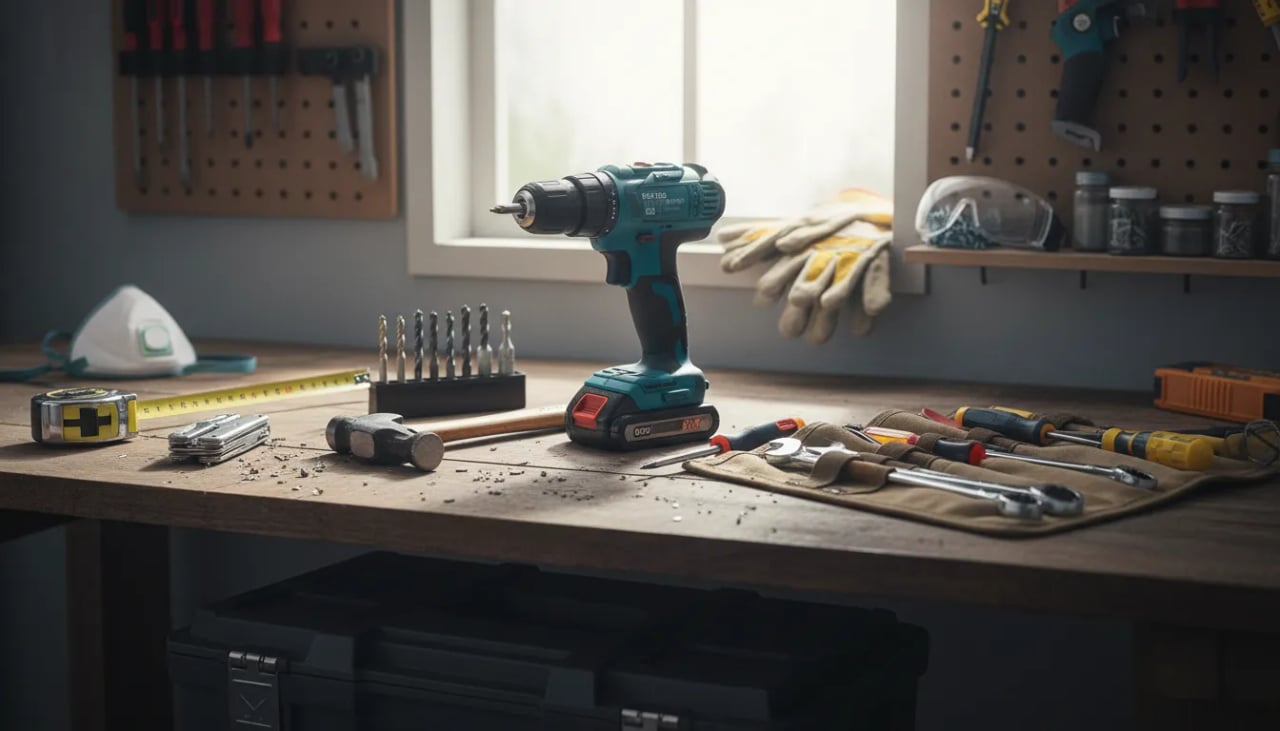
Cordless drill: my top single power-tool pick
If I could buy just one item from the Power tools aisle, it would be a Cordless drill. It’s the tool I reach for when I’m hanging curtain rods, assembling furniture, tightening loose hinges, or drilling pilot holes so wood doesn’t split. Research and homeowner checklists keep saying the same thing: a Cordless drill is the top recommended power tool because it’s so versatile.
"Invest in a cordless drill early; it's the most versatile power tool for homeowners." —
Think of it as your everyday Power drill that saves time and hand strain, even if you’re not a DIY expert.
Drill bit sets + an impact driver: the simple upgrades
A Drill bit set is what turns a Cordless drill into a real problem-solver. Most kits include 10–20 common sizes (it varies), which covers the basics for wood, drywall, and light metal. I keep mine in a small case so I’m not hunting for the right Drill bit mid-project.
When screws get stubborn, that’s where an Impact driver shines. It’s still one of those Power tools that feels “extra” at first, but it drives long screws with less effort and less cam-out (stripping). If you’re building shelves, mounting TV brackets, or doing deck repairs, pairing a Cordless drill with an Impact driver is a huge quality-of-life upgrade.
Battery size: light for quick fixes, bigger for longer jobs
I like a lighter Cordless drill for odd jobs—quick holes, a few screws, small repairs. For longer projects (lots of drilling or driving), bigger batteries last longer but add weight. My rule: choose the tool that feels comfortable in your hand first, then add a second battery later if needed.
What 2026 buyer guides say comes next
Many 2026 guides suggest expanding beyond hand tools with an Impact driver and a circular saw once you start tackling bigger projects. A circular saw is great for cutting lumber fast, but I don’t buy it until I know I’ll use it more than once.
Buy: Cordless drill, a solid Drill bit set, and (eventually) an Impact driver
Rent: big or one-off Power tools you won’t use often
Quick safety note
With any Power drill or other Power tools, I always wear eye protection and read the manual before the first use. It’s a small habit that prevents big mistakes.
Toolbox organization, maintenance, and small extras
I’ve learned that having the right tools is only half the battle—finding them fast is the other half. Good Toolbox organization turns a stressful “where is it?” moment into a quick fix, especially during everyday Home maintenance like hanging curtain rods, patching drywall, or tightening a leaky faucet handle.
"A tidy toolbox is a fast toolbox — label and return items for the next emergency." —
Hardware kit: the tiny time-saver I always restock
A Hardware kit is my secret weapon. I keep a small container of mixed screws, anchors, nails, and a few spare bits. It sounds basic, but it saves me from last-minute store runs when I’m installing curtain rods, mounting a hook, or doing minor plumbing tweaks under the sink.
Drywall anchors + matching screws (for shelves and rods)
Assorted nails (for quick trim fixes)
Spare screwdriver bits and a couple of common fasteners
Drill bit storage: label it once, thank yourself later
Loose drill bits are a mess, and digging for the right size wastes time. I use a small organizer and keep the sizes I use most right up front. If you only do light DIY, you still want your common bits easy to grab for pilot holes, curtain brackets, and basic repairs.
Use a labeled case or small portable organizer for each Drill bit size
Group by type: wood, masonry, and driver bits
Keep duplicates of your “most used” bits in the front row
Simple tool maintenance that keeps everything working
I try to do a quick reset after each job: wipe tools down, remove dust, and store them dry. For anything with moving parts (like pliers or an adjustable wrench), a tiny drop of oil keeps them smooth. I also replace dull blades—especially on my Utility knife—because a sharp blade is safer and cleaner for cutting drywall tape, opening boxes, or trimming caulk.
Small extras that earn their spot in my toolbox
These are inexpensive, but they show up constantly in real-life Home maintenance:
Utility knife and heavy-duty scissors for quick cuts and cleanup
Putty knife (great for drywall patching and scraping)
Caulking gun for sealing tubs, sinks, and drafty gaps
Paint rollers for touch-ups after repairs
Allen keys (store them together—furniture and fixtures love them)
Storage tips I actually use
Magnetic strips for small metal tools and bits
Pegboards for frequently used hand tools
Portable organizers for Hardware kit items and drill bits
Wild cards: quirky tips, scenarios & creative analogies
DIY essentials: the “only a screwdriver set” weekend
Picture this: it’s Saturday, the hardware store is closed, and all I’ve got is a screwdriver set with interchangeable bits. I can tighten a loose cabinet pull, swap a battery in a toy, open a stuck remote, and even nudge a door latch back into place. I can also remove a light switch plate to paint neatly (very home improvement energy). But I can’t cut a zip tie cleanly, measure for curtains, or persuade a nail that’s halfway out of the wall. And if a bolt laughs at me? Without an adjustable wrench, I’m basically negotiating with metal using hope and a Phillips head.
Home improvement analogy: a compact toolkit is mise en place
I think a complete tool setup works like a chef’s mise en place: everything in its place, ready before the heat is on. When my tape measure, level, utility knife, and pliers are easy to grab, the job feels smaller. That’s why I always start with core hand tools and expand later—hand tools are the real DIY essentials, even if you eventually add a drill. Quality tools (especially drills and solid sets) last through tiny day-to-day fixes and the bigger “why did I start this?” upgrades.
"If you only buy one extra thing, let it be a decent tape measure — it pays back in accuracy." —
Confession: I have mispronounced tool names in public
I once asked a store clerk where the “Phillips driver thingies” were, then confidently requested “ply-ers” like it rhymed with “flyers.” I’ve also called a level a “wall straightener,” which… honestly isn’t wrong. If you’ve ever used a butter knife as a screwdriver, you’re in good company. Tell me your best “butter-knife” story in the comments so we can all feel less alone.
First-night kit: 30-minute challenge for renters
Here’s my quick First-night kit challenge: set a timer for 30 minutes and build a starter kit that handles the first wave of surprises after moving in. Keep it in one small bag or box so it’s grab-and-go.
Screwdriver handle + Phillips/flat bits
Medium hammer
Combination pliers
Adjustable wrench
Tape measure
Small level
Utility knife/box cutter
Heavy-duty scissors
That’s my “survive the weekend” lineup—simple, human-proof, and ready for real life. If you build yours, you’re already ahead on home improvement, even before the first project begins.