



(Discover many other contents on: NOWO.ONE and NOWO Publishing)
I still remember a sub-zero morning run where my legs felt like two frozen noodles until a friend handed me a thermal tee that changed everything. That awkward, glowing relief is what drew me into obsessing over base layers—how they trap heat, move sweat, and let you keep training when everyone else is huddled inside. In this post I pull apart the science and the small practical choices (and a few opinions) that make thermal shirts and pants worth owning.
Why Thermal Base Layers Matter (Thermal Comfort & Clothing Insulation)
Second-skin fit: the easiest way I’ve found to manage thermal comfort
When I train in the cold, my base layer does most of the heavy lifting for thermal comfort. A snug, second-skin fit matters because it keeps warm air close to my body without bunching or flapping. That “hug” also helps with thermoregulation: as my effort rises and falls, the fabric stays in contact with my skin, so heat and moisture can move out in a steady way.
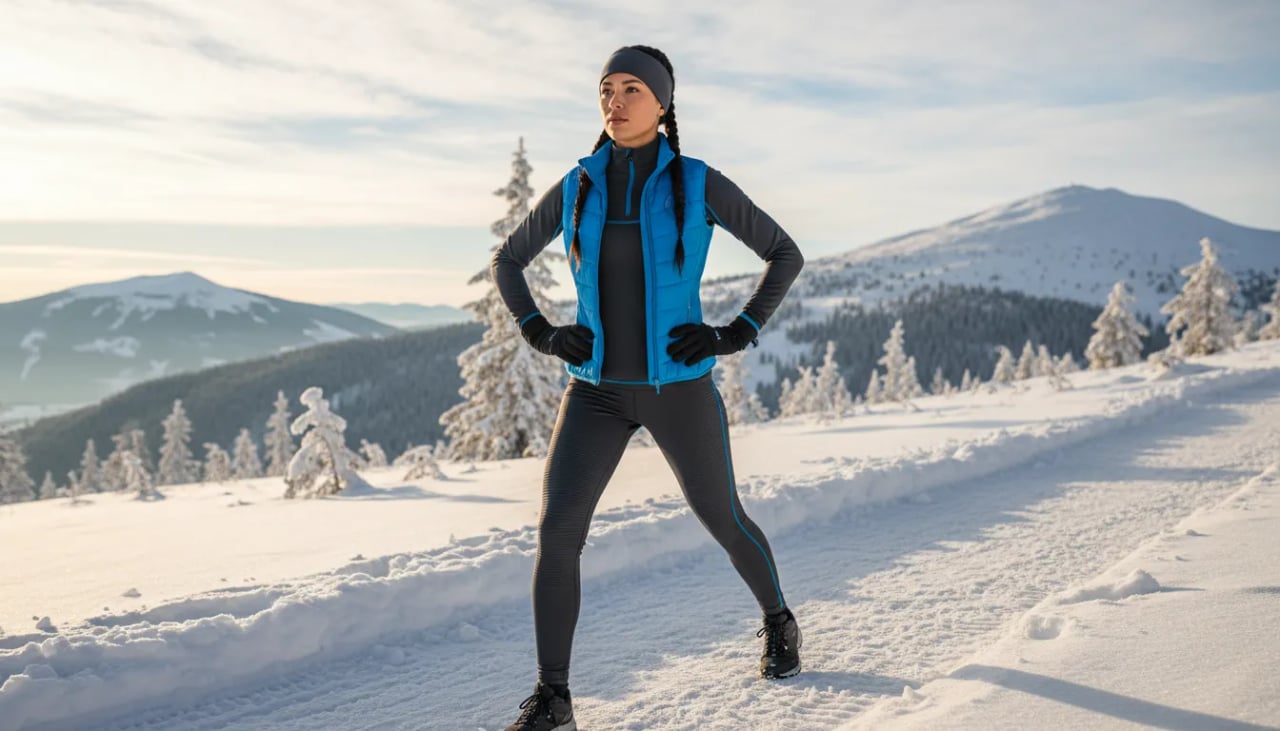
Good thermal shirts and pants for cold weather clothing are usually made from breathable, insulating technical fabrics with stretch. I like that they retain body heat but don’t restrict movement—whether I’m running, cycling, or trekking. The stretch fit also supports moisture evaporation, which is a big deal once I start sweating.
Insulating vs. trapping sweat: protective clothing needs balance
There’s a fine line between clothing insulation that keeps me warm and insulation that turns into a sweaty trap. If my base layer holds heat but can’t move moisture, I end up damp. Then the moment I slow down, that moisture chills fast—exactly what protective clothing should prevent.
For high-output runs: I prioritize breathability and fast drying, with “just enough” insulation.
For slower sessions: I can handle more insulation because I’m not generating as much heat.
What “clo” means in real life (running vs. trekking)
Designers often talk about insulation using clo, and it’s more practical than it sounds. Field data shows mean clothing insulation around 0.46 clo in warmer conditions and about 0.65 clo in cooler conditions. That difference is noticeable: 0.46 clo can feel great when I’m moving hard, while 0.65 clo can be the difference between comfort and shivering when I’m hiking slowly or stopping often.
Apparel teams also use metrics like Predicted Mean Vote (PMV) and Required Clothing Insulation to match thermal patterns to real conditions—basically, predicting how “too warm” or “too cold” a kit will feel during use.
Prof. Andersson, Thermal Comfort Expert: "Clothing insulation is the single most practical variable athletes can tweak to stay comfortable in the field."
My quick lesson from one cold hike
On one winter hike, I wore a base layer that was warm but not breathable. I felt fine on the climb, then got soaked with sweat. At the windy ridge, I cooled down fast and the day turned miserable. The next trip, I switched to a better-fitting thermal set that breathed while still insulating, and it completely changed the experience—same trail, same weather, but steady comfort.
Fabric Choices: Wool, Linen, Hemp and 'Fabric Frequency'
Picking base layers by real-world performance (not hype)
When I train in the cold, I want thermal shirts and pants that feel like a second skin: they hold warmth, breathe, and let sweat evaporate so I don’t get chilled mid-run. That’s why I pay attention to textile fibers first, then the build (stretch, yarn weight, weave). Here’s how Wool Fabric, Linen Fabric, and Hemp Fabric stack up for base layers.
Wool Fabric: Best warmth-to-weight, stays comfortable when damp, and odor control is strong. Downsides: can itch if the knit is coarse, and it costs more.
Linen Fabric: Feels cool and dries fast, but for true cold training it can feel “crisp” and lose warmth when wind hits. Odor control is okay, not great.
Hemp Fabric: Tough, naturally breathable, and often a sustainability favorite. For base layers it can feel rough unless blended or finely spun; warmth is moderate.
What people mean by fabric frequency (and why I’m cautious)
I keep seeing the term fabric frequency in eco-fashion circles, including a Project CeCe-style claim that “high frequency” fabrics like wool and linen sit around 5,000 MHz. This number is often linked to Dr. Yellen’s 2003 work, but it’s not consistently validated in mainstream textile science. As Dr. Yellen, Textile Researcher (2003) put it:
Dr. Yellen, Textile Researcher (2003): "High-frequency fabric claims raise interesting questions, but the evidence is mixed and often overstated."
To me, “frequency” talk often reads like marketing. What is well supported is that vibration spectrum analysis can identify tactile fabric properties—like roughness, hardness, yarn weight, and weave—with >90% accuracy. That’s about measurable feel, not mystical energy.
My quick experiment: two cold runs, same pace
I did two 40-minute runs at the same pace in similar temps. Run 1: merino Wool Fabric top + tights. Run 2: a hemp-blend base layer.
Smell: wool stayed noticeably fresher; hemp picked up more odor.
Wetness: wool felt less “clammy” even when damp; hemp dried but felt cooler against wind.
Comfort: wool’s stretch hugged better; hemp felt slightly scratchy at seams.
Why yarn weight and weave pattern matter as much as fiber
Even within the same fiber, yarn weight and weave pattern change insulation and touch. A heavier yarn or tighter knit traps more air (more warmth), while an open weave vents better but can feel colder. That’s why I treat “high frequency” claims as secondary—sustainability and comfort come more from smart construction than a single number.
Fit & Feel: Tactile Perception, Movement and Vibration Spectrum
Second-skin stretch: freedom of movement + microclimate control
When I pull on a good thermal shirt or pant, I want that second-skin fit—snug, stretchy, and never stiff. For cold training, fit isn’t just style; it’s thermal comfort. A close fit reduces cold air pockets, so my body can hold a stable microclimate while the fabric still breathes and lets sweat evaporate. That matters when I’m running, cycling, or trekking and my skin temperature keeps shifting. Studies using 2D/3D thermal distributions and skin temperature mapping back this up: where the garment hugs (or gaps) changes heat loss and where insulation should sit.
Tactile Perception cues: what “soft,” “rough,” and “crispy” really mean
My tactile perception is basically my first performance test. “Soft” often signals a brushed or peached finish that feels cozy and can reduce friction. “Rough” can mean thicker fibers, a more open knit, or a finish that grabs skin—sometimes durable, sometimes annoying. “Crispy” usually hints at a tighter weave or stiffer yarn that may block wind better but can feel less forgiving in motion. The key insight: touch is shaped by fiber type, yarn, and finishing processes, so the same “warm” label can feel totally different on my skin.
Dr. Lane, Sensory Textile Specialist: "Perception is a mix of physics and memory—what feels warm is often what reduces local heat loss."
Vibration Spectrum: comfort you notice when you move
Here’s the nerdy part I’ve learned to respect: the vibration spectrum of a fabric—how it responds to movement—changes comfort during activity. Harder fabrics can “buzz” against the skin, while softer structures dampen that sensation. Yarn weight and weave/knit structure also shift how the fabric flutters, slaps, or stays quiet when I pick up pace. Vibration spectrum analysis can even identify weave and yarn attributes with >90% accuracy, which explains why my legs can “tell” the difference between two similar-looking tights on a windy ride.
My rant: seams that rub + layering choreography
If a seam hits the wrong spot, no amount of insulation saves the day. I’ve had flat seams still rub when the fit was slightly off and sweat made everything stickier—instant hot spots. My layering rule is simple: keep the base layer smooth, then add warmth outside it.
Check seam lines at shoulders, inner thighs, and waistband.
Match compression to sport: tighter for running, slightly freer for trekking.
Don’t judge on a hanger—test fabric sensation by mimicking your sport: high knees, deep squat, cycling bend, arm swings.
Smart Clothing & Phase Change Materials: When Tech Helps (and When It Doesn't)
How phase change materials actually work (and why placement matters)
In cold training, my go-to is still a solid thermal shirt and pants made from breathable, insulating technical fabrics. When they fit like a second skin, they hold warmth without locking me up, and they move sweat out so I don’t get that damp chill.
Phase change materials (PCMs) add a “thermal buffer.” They absorb heat when I’m warming up and release it when I cool down. The key is that they work best when used selectively—in high-need regions—rather than spread everywhere. That matches what I’ve seen in practice: targeted comfort beats a full-body gimmick.
Dr. Mei Chen, Smart Textiles Researcher: "PCMs offer promise, but designers must be surgical about placement to avoid unnecessary weight."
Smart clothing trade-offs: comfort gains vs weight, cost, and complexity
I like smart clothing when it solves a real problem, not when it adds problems. PCM panels and pockets can improve localized comfort, but they can also add bulk, slow drying, and raise the price. If the garment already regulates well—stretchy, breathable, and insulating—extra tech may not change my performance much.
Where I’m cautious is marketing spin. If a brand talks about “adaptive warmth” but shows no thermal data or lab testing, I treat it like a buzzword. Real claims should be measurable, not just a logo on the sleeve.
Scenario: a multi-day trek with PCM pockets—how I’d pack
On a multi-day trek, my biggest cold hit is usually at camp and overnight. That’s where I’d consider protective clothing with PCM pockets placed at the chest and upper back (my personal “high-need” zones).
Base layer: technical thermal top + leggings (close fit for moisture control)
Mid layer: light fleece for adjustable warmth
Outer: wind shell for stops and exposed ridgelines
PCM add-on: targeted pockets for evenings, not necessarily for the whole day
Design is getting smarter: body scanning + virtual garments
One trend I’m watching is body scanning and virtual garment tools. They can improve fit and reduce design waste, and they also help place PCMs where they matter most—based on heat maps and thermal data, not guesswork.
Quick buyer’s checklist for “smart” base layers
Validated PCM use: ask for lab results or clear thermal testing, not vague promises
Targeted placement: panels in specific zones, not heavy coverage everywhere
Washability: confirm the PCM performance survives normal washing
Real-world comfort: stretch, breathability, and moisture evaporation still come first
Field Checklist & Real-World Tests (Running, Cycling, Trekking)
My quick field checklist for cold weather clothing
When I pack protective clothing for winter training, I start with the idea that activity intensity should guide insulation. High output = lower Required Clothing Insulation (lower clo). Low movement = higher clo. I also look for stretch “second-skin” pieces that breathe, hold heat, and don’t block movement—this is where smart thermal patterns matter.
Short run (high output): thermal shirt + light wind layer, thin tights, gloves; skip heavy midlayers.
Cold ride (steady + wind chill): thermal top + windproof shell, thermal tights, neck gaiter, warmer socks.
Multi-day trek (stop/start): thermal base set, midlayer, packable insulated layer, spare dry base, sleep socks.
Two-week winter cycling trial: what I kept vs. tossed
On my two-week cycling test, I learned fast that wind changes everything. I kept a close-fit thermal top because it managed sweat and kept my Skin Temperature stable under a shell. I tossed a bulky “warm” jersey that felt cozy at the start but got clammy after climbs. The best pieces had mapped panels—thicker on the chest and thighs, lighter under arms and behind knees—classic Thermal Patterns in action.
Anna Ruiz, Outdoor Coach: "Fit and moisture management will beat a thicker fabric every time on a long run."
How I read labels (and ignore hype)
I scan for fabric blends (polyester/nylon + elastane), brushing/fleece inside, and “recommended activities.” If a brand throws out strange claims—like the 2003 controversial fabric frequency number of 5,000 MHz—I treat it as marketing, not performance data. I’d rather see insulation guidance or lab-style notes.
Simple clo guide + mini-experiments you can run
From database analysis, mean clothing insulation values often sit around 0.46 clo (warmer conditions) and 0.65 clo (cooler conditions). I use that as a rough range, then adjust by output: lower clo for hard runs, higher clo for slow hikes or long stops.
Activity | Output | Suggested approach |
|---|---|---|
Running | High | Lower effective clo; prioritize breathability |
Cycling | Medium | Moderate clo + wind block |
Trekking | Low/variable | Higher clo; add/remove layers often |
Wear one thermal set for 30–45 minutes; rate sweat (1–5) and comfort (1–5).
Repeat at a different pace or temperature; note changes in Skin Temperature feel.
If you can, compare photos from Thermal Imaging; designers use Thermal Imaging and 2D/3D mapping to place insulation where heat loss is highest.
Care notes that change feel and warmth
Washing too hot, using softeners, or over-drying can flatten loft and change tactile feel, which can reduce perceived warmth over time. I wash cold, skip softener, and air-dry to keep insulation and stretch working.
Design Forward: Body Scanners, Virtual Garments and the Future of Base Layers
From Body Scanner to Virtual Garments: fit first, prototypes later
When I think about the next leap in cold-weather training gear, I don’t start with fabric—I start with a Body Scanner. A good scan gives me a clean 2D/3D map of the athlete’s shape, and that becomes the base for Virtual Garments. Instead of sewing sample after sample, I can test fit, stretch, and seam placement in a digital space first. That means fewer prototypes, lower cost, and a better chance the base layer will feel like a second skin—snug, breathable, and free to move in.
What really changes the game is when the scan is paired with skin temperature data. Research using thermal imaging shows that heat is not spread evenly, and thermal distributions shift by BMI and activity. That insight lets me build targeted insulation into the pattern, rather than guessing.
Thermal Pattern Variations and smarter Apparel Design outside neutral zones
Cold training pushes us outside thermal-neutral zones, where the body works harder to stay warm. That’s where Thermal Patterning and thermal pattern variations matter most. Instead of making thermal shirts and pants that are uniformly thick, I can design for real heat loss and sweat zones: more insulation where the body cools fast, more ventilation where moisture builds. This is the heart of modern Apparel Design for protective and smart clothing—thermal regulation plus moisture evaporation, without restricting movement.
Marcus Lee, Apparel Designer: "Designers who map thermal zones win: it's more about targeted insulation than one-size-fits-all thickness."
In practice, I also weigh textile choices carefully: fibre type, weave, and finishing all change both tactile feel and thermal outcome. A fabric can be warm but clammy, or light but leaky—details that show up fast in winter runs and rides.
A quick look at 2030: adaptive warmth, selective PCMs, better sensing
By 2030, I expect base layers to look less like “one fabric everywhere” and more like a mapped system. Selective phase change materials (PCMs) could sit only in high-need thermal regions for better effectiveness. I also see better tactile sensors that read moisture and skin temperature, feeding simple adjustments in knit structure or venting zones over time.
Closing: design in thermal zones, not blanket insulation
My biggest takeaway is simple: stop designing for average cold. Design for zones. Use a Body Scanner to build Virtual Garments that reflect real bodies, then layer in thermal pattern variations guided by thermal imaging. And if we want predictions to hold up in the field, collaboration between thermal comfort researchers and apparel designers is the fastest way to reduce variability and deliver base layers that stay warm, dry, and fast in low temperatures.