



(Discover many other contents on: NOWO.ONE and NOWO Publishing)
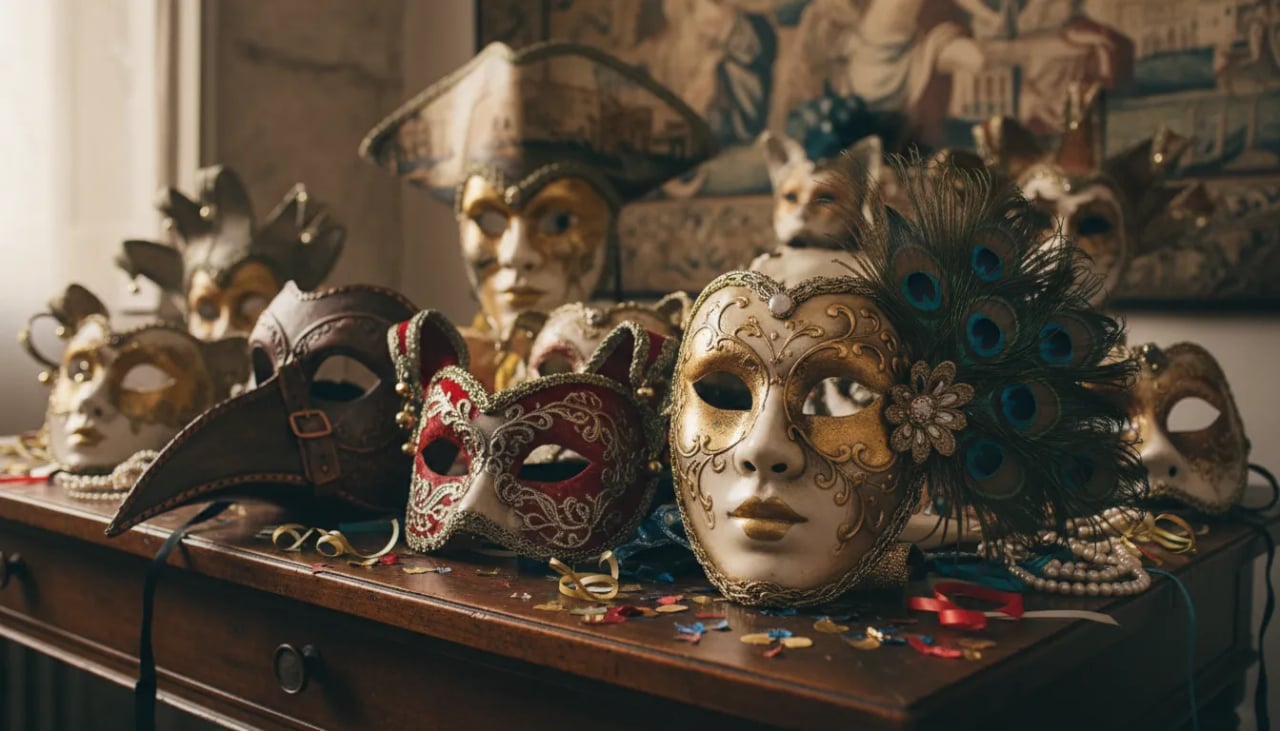
I remember the first time I saw a real Venetian mask up close — a friend handed me a feathered Bauta on a damp February evening and for a second I felt untouchable. That odd, delicious feeling — anonymity mixed with performance — is exactly why I fell down the rabbit hole of researching Venetian Carnival Masks. Fun fact: masks were officially recognized by the Venetian Senate in 1296, and workshop records go back to 1271. In this post I'll walk you through history, types, making, and a few of my own sometimes silly encounters.
Origins & Early History: Why Venice Hid Its Faces
When I think about the Carnival Mask Origin, I don’t picture a simple costume piece. I picture a city choosing, on purpose, to blur the lines between people. In Venice, masks became symbols of celebration, joy, and tradition—bright with feathers, glitter, and rich fabrics—yet their real power was simple: they let you hide your identity and step into a new role.
Thirteenth Century Origin: the first faces disappear
The Thirteenth Century Origin of Venetian masks goes back to the 1200s, when pre-Lent celebrations began as early as December 26. This timing mattered. Winter was long, work was hard, and the city needed a release before Lent’s rules arrived. Records also point to mask-making as a real trade: by 1271, we see early mentions of workshops, showing that this wasn’t a passing trend—it was becoming a craft and a business.
1296: Venice Carnival Tradition becomes official
In 1296, the Venetian Senate officially recognized the carnival. To me, that civic stamp is a turning point in Carnival Mask History. It meant the city wasn’t just allowing the party; it was organizing it. A public celebration with official approval gave masks a special kind of safety—like a temporary license to play.
Dr. Marco Rossi, Historian of Venetian Culture: "Masks didn't just hide faces — they rewired social rules in Venice, creating a sanctioned realm of freedom."
Social class mingling: status erased, mischief invited
One reason Venice hid its faces was social. Masks helped suspend sumptuary laws—the rules that controlled what people could wear and how they could show status. Behind a mask, nobles and servants could mingle, and the city’s usual order softened.
Gambling felt easier when no one knew your name.
Affairs could begin with a glance and a mystery.
Mischief thrived because identity was blurred.
Protection and the Medico della Peste roots
Not every famous mask began as a party symbol. The Medico della Peste, or Plague Doctor Mask, was designed in the 17th century by Charles de Lorme as protective gear. Later, Venice adopted its long beak and eerie look as a carnival trope—proof that fear and fun can share the same costume.
By the 18th century, Venetian carnival reached a cultural peak, and masks became more theatrical and opulent. But the heart of the tradition stayed the same: concealment, celebration, and the thrill of becoming someone else for a while.
Iconic Types: Bauta, Volto, and the Medico Della Peste
When I first learned about the Traditional Venetian Mask, I realized it’s not just decoration. During Carnival, masks become symbols of celebration, joy, and tradition. They let us hide our identity and have fun by stepping into a different role, and that simple change can make the streets feel magical and playful.
Bauta Mask Design: function meets mystery
The Bauta Mask Design is one of the most classic choices in Venice. It covers the upper face and has a shape that famously made it easier to eat and drink without taking it off. That practical detail matters during long nights of music and conversation.
I also love how the Bauta is often paired with the black tricorno hat, which finishes the disguise and adds a strong silhouette.
Giulia Moretti, Venetian Maskmaker: "When I teach Bauta Mask Design, I always stress the mix of function and mystery — the hat completes the disguise."
Volto Larva Mask: the comfort of anonymity
The Volto Larva Mask (often just called Volto) is a full-face white mask, traditionally made from waxed cloth or a similar smooth finish. People sometimes call it “larva” because of its ghostly white simplicity. When I picture it worn with a cloak and hat, I understand why it became a favorite: it offers real anonymity, and it’s comfortable enough to wear for hours.
Look: clean, pale, and timeless
Feel: easy to wear, easy to move in
Effect: you become “anyone,” which is the point
Medico Della Peste: the Plague Doctor Mask with a double meaning
The Medico Della Peste, also known as the Plague Doctor Mask, stands out with its long beak. It began as a protective medical design in the 17th century, often linked to Charles de Lorme. Later, Carnival reimagined it with dramatic fabrics, dark cloaks, and theatrical flair.
To me, it carries a double meaning: protection and memento mori—a reminder of mortality—wrapped into a costume that is now a bold Carnival icon.
Commedia dell’Arte and the rise of character masks
By the 18th century, theatrical and elaborate designs flourished, and Commedia dell’Arte helped shape what people wore. Characters like Arlecchino and Pantalone inspired masks that blended function and fantasy, turning the city into a living stage.
How They're Made: Materials, Workshops, and the Comeback
From simple faces to Hand Painted Masks
When I first watched a Traditional Venetian Mask take shape, I understood why these pieces feel alive. Carnival masks began as simple ways to hide identity and step into a new role. Over time, they evolved into elaborate creations—bright, playful, and full of character—made to match historical figures, popular types, or pure fantasy. Today, the best ones still carry that old promise: anonymity, joy, and a little magic.
Materials that signal status
In Venice, materials are never random. A plain larva (often linked to the Volto style) can look clean and quiet, while a luxury masquerade mask may shine with Gold Leaf Decoration, gems, and rich fabrics. Most makers start with a smooth base, then build up the personality through color and texture.
Gesso for a firm, paint-ready surface
Papier-mâché for lightness and comfort
Wax cloth often used for Volto-style finishes
Feathers, gems, glitter, and precious fabrics for drama
Technique matters: papier-mâché, Volto, and gold leaf
I’ve learned that the “wow” effect comes from patience. Papier-mâché is layered, dried, and shaped so the mask sits well on the face. After that, gesso is applied and sanded until it feels like porcelain. Then come the Hand Painted Masks details—shadows, patterns, tiny lines that suggest age, mischief, or nobility.
For high-end pieces, Gold Leaf Decoration is its own ritual. The surface is prepared, adhesive is brushed on, and the leaf is laid down in fragile sheets that catch every breath of air.
Luca Bianchi, Master Artisan: "Applying gold leaf is meditative — it's how a mask stops being an object and becomes a personality."
Mask Workshops Venice: a craft with deep roots
Venice has documented mask-making as far back as 1271, and that continuity still shows. Modern Mask Workshops Venice often feel like a bridge between medieval craft and today’s travel culture: apprentices learn tradition, while visitors take short classes and leave with paint on their hands.
In many workshops, I’ll see guides mention the full Bauta look too—especially the Black Tricorno Hat—because the mask is only part of the costume story.
The comeback: making it yourself
What I love most about the modern revival is access. Alongside ateliers, DIY kits now let travelers try the process at home: prime with gesso, paint, add feathers, and finish with a touch of shine. It’s not just a souvenir—it’s a small way to step into Carnival’s playful tradition.
Personal Anecdotes & Tangents: Confessions of a Part-Time Mask Wearer
Volto Night: Mask Identity Concealment in Real Time
I once wore a simple Volto to a small carnevale get-together—one of those cozy Carnival Season Parties where the music is loud, the lights are low, and everyone’s costume is held together by hope. The second I tied it on, I felt it: Mask Identity Concealment isn’t just hiding your face. It’s like picking a stage name for your face. People stopped asking what I do for work and started guessing who I was “supposed” to be.
Within ten minutes, strangers invented a whole backstory for me. One person decided I was a visiting count. Another swore I was a shy artist. I barely spoke, yet the room filled in the blanks anyway. It matched something I later read about masks creating playful anonymity that encourages social experimentation. You try on a role, and everyone else helps you keep it.
Alessandra Ferri, Cultural Commentator: "Wearing a mask in Venice is an act of storytelling — you choose a role and people fill in the rest."
Tangent: The One-Day Bauta Experiment (and Social Media Panic)
Now imagine a world where everyone wore a Bauta for a day. Same outfit, same blank authority, same hidden mouth. How would social media handle anonymous compliments? Would “nice shoes” finally be pure, with no profile stalking? Or would we all post masked selfies with captions like #DefinitelyNotMe and still find a way to brag?
Part of me thinks we’d love it for a few hours—then panic when we couldn’t “verify” anyone. If Venice banned masks tomorrow, would we mourn the loss or adapt with digital avatars? I can already picture the app: choose your Volto filter, add glitter, hit upload.
Medico Della Peste: Memento Mori Under the Feathers
The Medico Della Peste always stops me. It’s dramatic, yes, but it’s also a reminder: pleasure and mortality often walk hand-in-hand. That long beak feels like a wearable memento mori, even when it’s decorated with gold trim and soft fabric. Carnival joy can be bright, but it’s never totally forgetful.
Oddities: Commedia Dell Arte Meets a Fashion Shoot
I once visited a boutique atelier where a Commedia Dell Arte mask—sharp nose, bold brows—ended up in a modern fashion shoot. The stylist paired it with streetwear and glossy boots. Mashups happen. Today, masks live in tourism, fashion, and theatrical revivals: modern mask shops sell ready-to-wear pieces, DIY kits tempt tourists, and workshops still shape papier-mâché like it’s a living craft.
Carnival Today: Tourism, Workshops, and the Culture Industry
When I walk through Venice during Carnival, I feel how the Venice Carnival Tradition has shifted from a local rhythm to a global stage. Masks are still symbols of celebration, joy, and tradition, and they still let us hide our identity and step into a new role. But today that magic is often packaged as an experience: guided walks, photo stops, and Carnival Season Parties where everyone arrives ready to play a character—historical, popular, or pure fantasy.
From 18th-Century Opulence to Tourism-Driven Revival
People love to say the 18th century was the peak of Venetian carnival opulence, and I can see why: the stories, the costumes, the sense of endless theater. Modern Venice can’t recreate that world exactly, but tourism has powered a revival of events and mask demand. Luxury, hand-painted pieces now sit beside inexpensive souvenir versions, and both are bought for the same reason: to join the spectacle, even for one night.
Mask Workshops Venice: Where Craft Becomes Culture
My favorite part of the modern carnival is the rise of Mask Workshops Venice. These studios don’t just sell; they teach. Preservation of craft techniques is critical to keeping authenticity, so many artisans still demonstrate papier-mâché, careful sanding, and the slow build of color. Some workshops also show gold leaf application, which turns a simple surface into something that catches candlelight and camera flash alike.
Francesca Neri, Carnival Guide: "Tourists breathe life into workshops, but real revival happens when apprentices learn the old techniques."
Learning the Medico Della Peste Story
In several classes I’ve visited, the Medico Della Peste is a lesson, not just a look. Teachers explain how the beak shape began as a medical idea and later became a metaphor—fear, protection, mystery. Watching that history while painting makes the mask feel less like a prop and more like a living symbol.
Traditional Carnival Masks vs. Souvenirs: Conservation and Commerce
The big debate I hear in shops is simple: how do we protect Traditional Carnival Masks while meeting modern demand? The answer isn’t neat, but it helps to know what you’re buying.
Handmade masks: often papier-mâché, hand-painted details, sometimes gold leaf and fine fabrics.
Mass-produced masks: cheaper, quick to buy for parties, but less tied to local techniques.
Today, social class mingling looks less like secret meetings and more like cultural consumption: tourists purchase a mask to enter a curated moment. Still, when workshops train new hands, the tradition stays real—not only worn, but made.
Conclusion: Wear One, Respect It, and Tell a Story
Venetian Carnival Masks are not just decoration
When I first held a mask in Venice, I expected a pretty souvenir. Instead, I felt the weight of a social tool that changed how people moved through the city. From the 13th century onward, Venetian Carnival Masks helped “rewire” public life—letting strangers speak freely, mix across class lines, and step into roles they could never claim in daylight. The timeline matters: early workshop records appear in 1271, and the Venetian Senate gave the carnival official recognition in 1296. By the 13th–18th centuries, the tradition had reached its peak, shaped by key artifacts like the Bauta, the Volto, and the Medico della Peste.
Traditional Venetian Mask craft deserves protection
Touching a hand-painted piece—real papier-mâché, careful gilding, fabric laid down like a whisper—connects me to centuries of craft. That’s why I try to support authentic workshops, not factory copies. Craft preservation and experiential tourism keep the tradition alive: when you visit a studio, watch the layers build, and try painting your own, you’re not just shopping. You’re helping a living skill survive. As Venetian maskmaker Giulia Moretti says:
“Every mask holds a story; if you listen, you'll hear Venice speak in feathers and gold leaf.”
From Bauta Mask Design to Volto Larva Mask—and the Plague Doctor Mask
I love how each form carries a different kind of freedom. The Bauta Mask Design feels bold and civic, built for moving through crowds with confidence. The Volto Larva Mask is quieter—smooth, pale, and dreamlike, like a blank page waiting for a new identity. And then there’s the Plague Doctor Mask, also known as Medico Della Peste: it’s striking, theatrical, and unforgettable, but it also carries a double-edged symbolism—part costume, part reminder of fear, illness, and the stories cities tell to survive them.
“A masked face can free the heart.” I repeat that line to myself when carnival season parties feel like pure spectacle. They aren’t. They’re living history.
My takeaway is simple: learn the history, try a workshop in Venice, read primary sources when you can, and support artisan makers online. Then do one small creative exercise: design a Traditional Venetian Mask that reveals one secret about you—and hides another.