



(Discover many other contents on: NOWO.ONE and NOWO Publishing)
I still remember the first time I held a Venetian mask in my hands—cold papier-mâché warmed by my palm, gold dust flaking like a small secret. That afternoon, an old mask-maker in a back alley told me an unexpected fact: the earliest bans on masked gambling date back to 1268. That tiny, odd detail hooked me. In this post I mix history, hands-on craft notes, and a few wobbly personal anecdotes to explain why Venetian Masks feel both like theater and a sly social experiment.
Up Close: How I Fell for Venetian Masks (Venetian Masks)
My first Volto Mask, in a quiet calle
I didn’t fall for Venetian Masks in a museum. I fell for them in a narrow Venetian calle, where a small shop door stood open and the air smelled like glue, paint, and damp stone. A Volto Mask hung near the entrance—plain, pale, and calm. The Mask Makers always say “look,” but that day I asked, “Can I touch it?” The maker nodded, and the moment my fingers met the papier-mâché, I understood why people call these Carnival Masks mysterious. It was light, almost warm, with tiny bumps where the layers had dried.
Why materials matter (this is tactile art)
That touch changed how I saw the craft. Venetian masks aren’t just pretty faces; they’re tactile art pieces. The identity of a mask lives in its materials: papier-mâché that flexes slightly, ceramic that feels cool and firm, and precious fabrics that soften the edges of a bold shape. The maker showed me gold leaf up close—so thin it seemed like it could float away—and a strip of velvet that drank in the light. Feathers waited in a jar like bright punctuation marks.
“Masks change the way you move through a room — they grant a small, sanctioned mischief.” — Dr. Lucia Moretti, Venetian mask historian
That “sanctioned mischief” is old. Masks were already causing social ripples in the 13th century, when anonymity meant freedom. By 1268, Venice had an early documented ban tied to masked gaming—proof that hiding your face could change how you behaved, and how others treated you.
My bargain turned into a lesson on the Bauta
I tried bargaining (gently) and, instead of getting a quick discount, I got a mini lecture. The maker explained the Bauta: how it was worn with a cloak and hat, and how its shape helped you speak and drink without removing it—perfect for staying anonymous during Carnival. He even mentioned quirky rules, like bans on throwing ovi odoriferi (scented eggs). Venice didn’t just love masks; it had to manage them.
The first mask I bought
In the end, I paid, and the maker wrapped my Volto like a fragile pastry. When I stepped back into the cold, I laughed: the first mask I bought hid nothing of me except my cold nose. Still, I felt different—lighter, bolder—like Carnival had started early. And maybe that’s why the traditions, revived again in 1979, still pull us in: one touch, and you want to become someone else for a while.
Origins & Timeline: From 13th Century to 1979 (History Venetian, Venice Carnival)
When I first started digging into the History Venetian mask tradition, I realized it isn’t just about beauty—it’s about power, privacy, and public life. In Venice, a mask could turn a noble into “nobody,” and that anonymity made the Venice Carnival feel like a rare space where rules could bend.
From victory parties to early rules (1162–1268)
The story often begins with 1162, when Venice celebrated a military victory with public festivities—an early seed of what became Carnival. By the 13th Century, masks were already part of the city’s culture, used to hide identity and loosen social boundaries. But Venice also regulated behavior fast. In 1268, we get a key documented mention tied to a ban on certain games—proof that masked fun and public order were already colliding.
1436: the mascherari guild makes it official
In 1436, mask-makers—known as mascherari—formed a guild. To me, this is the moment masks shift from “party accessory” to a protected craft. The guild helped standardize materials and methods, keeping the tradition alive through rules, training, and quality control. Even today, when I see papier-mâché, ceramic, rich fabrics, gold, and feathers, I think of that long line of regulated artistry.
“The mask was both a costume and a social equalizer — Venice wrote its laws around that paradox.” — Professor Marco Bellini, historian of Venetian culture
18th-century peak: Baroque spectacle and social mixing
The 18th century was the height of Carnival spectacle—pure Baroque drama in the streets. Masks became a social tool: merchants, nobles, visitors, and workers could mingle without the usual barriers. That freedom wasn’t only personal; it was political. Anonymity allowed cross-class interaction, secret conversations, and a kind of public “reset” where status mattered less—at least for a night.
Quick tangent: Commedia dell’Arte and Columbina
The theater also shaped mask style. Commedia dell’Arte influenced familiar forms, including the half-mask look of Columbina, designed to frame the eyes and keep expressions lively on stage and in the crowd.
1797 ban, then Revived 1979
My biggest takeaway is how mask popularity tracks Venice’s political fortunes. After the 1797 Fall of the Republic, public Carnival was banned, and under later political shifts (including Austrian rule), the tradition faded from everyday street life. Still, the craft endured in quieter forms—until the modern Revived 1979 return of the Venice Carnival, when masks re-entered the public imagination as living heritage, not just museum history.
The Masks Themselves: Types, Materials & Makers (Mask Makers, Bauta Mask)
Venetian masks have always felt like the city’s most beautiful secret. Centuries ago, people wore them during Carnival to hide who they were—suddenly you could speak freely, flirt, or cross social lines without your name getting in the way. Today, that mystery lives on, but the craft is what grabs me most: handmade forms in papier-mâché or ceramic, dressed up with gold, feathers, and rich fabrics.
Iconic Types: Bauta Mask, Volto Mask, Moretta Mask & Friends
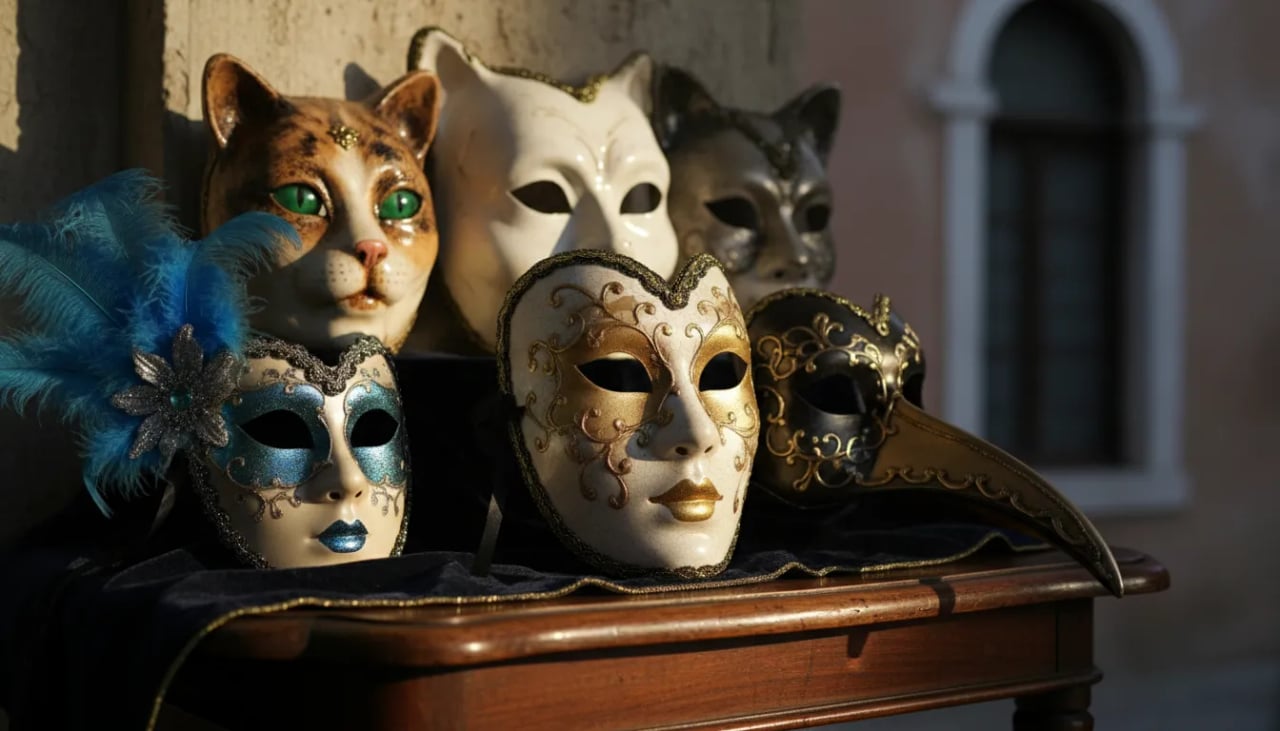
Bauta Mask: a full-face classic designed for real life, not just looks. Its shape allowed the wearer to eat, drink, and speak more easily—perfect for social dining while staying anonymous.
Volto Mask: another full-face style, often smoother and more “portrait-like.” I see it as the clean canvas that makers love to paint, gild, and decorate.
Plague Doctor: born in the 17th Century, with the long beak that started as functional and became symbolic. It’s eerie, theatrical, and unforgettable.
Moretta Mask: my favorite oddity—usually black velvet, and traditionally held in place by biting a small button inside. No strap, no talking, just presence.
Columbina: a half-mask tied to performance and Commedia dell’Arte, leaving the mouth free for smiles, jokes, and drama.
Materials, Status, and the Mascherari Tradition
Materials don’t just change the look—they signal value. Papier-mâché keeps a mask light and wearable; ceramic adds weight and shine. Luxury shows up in gold leaf, artisan fabrics, velvet, and feathers. In 1436, the mascherari guild formalized mask-making, protecting techniques and setting quality standards that modern Mask Makers still echo today.
“Real masks carry the fingerprints of three generations—the hand tells the story.” — Elena Rossi, master mask-maker
Watching a Mask-Maker Work (and How to Spot the Real Thing)
I once watched a maker apply gold leaf with a rabbit-hair brush—slow, careful, almost ritual-like. It was humbling, because nothing about it could be rushed.
When I compare souvenir shop masks to artisan pieces, the difference is clear:
Authenticity signs: hand-applied gold, clean edges, strong but light structure, and a signed interior.
Factory clues: plastic shine, printed patterns, rough glue marks, and fabrics that feel thin.
And yes, Venice has historical oddities too—like ovi odoriferi (“scented eggs”) tied to masked festivities—proof that behind every mask is a whole world of strange, playful tradition.
Why Masks Matter: Symbolism, Social Freedom, and Theatrics (Masks Symbolize, Why Masks)
Anonymity Freedom: the sweet power of not being “you”
To me, Venetian masks symbolize a simple but thrilling idea: Anonymity Freedom. In a city built on trade, gossip, and tight social rules, covering your face meant you could step outside your usual role. During the Carnival Tradition—which traditionally builds toward Shrove Tuesday—masks helped people mingle without the weight of names, jobs, or family ties.
“Masks functioned as social currency; they bought a night’s worth of anonymity.” — Dr. Paolo Vitale, social historian
Historical accounts describe how anonymity encouraged rule-bending: masked visitors could slip into gambling rooms, flirt boldly, or join parties they’d never be invited to otherwise. It wasn’t only romance and laughter; it was also mischief, because the mask made consequences feel far away.
Social Classes: when the lagoon blurred its own lines
Venice was famous for its strict Social Classes, yet Carnival let those lines soften. A noble could stand beside a sailor, a merchant could chat with a servant, and nobody had to prove who they were. That mixing is part of why masks became such a lasting symbol of the city—handmade in papier-mâché, ceramic, and rich fabrics, then finished with gold, feathers, and bright color.
Cross-class mingling without introductions
Taboo fun like gambling with less fear of arrest
Freedom of expression—bolder talk, riskier jokes, louder laughter
Commedia Dell: theater that shaped real life
Mask styles didn’t grow in a vacuum. Venetian taste was deeply tied to performance, especially Commedia Dell traditions. Characters like Columbina helped define what a “playful” mask could look like—lighter, flirtier, and made for quick movement. Theatrical habits also shaped social behavior: masks weren’t just worn, they were played.
I felt that myself the first time I wore one. I spoke louder than usual, used bigger hand gestures, and flirted with mannerisms I normally save for stage roles—like the mask gave me permission to perform.
Morality laws: Venice tried to control the mask
Of course, the government noticed what anonymity could unlock. Venice issued ordinances to contain mask-enabled behavior, with bans and fines during certain periods. Some rules targeted specific acts—records mention restrictions on masked people doing things like throwing scented eggs. The message was clear: masks could mean liberation, but they could also invite trouble, so the city kept trying to draw a line.
Modern Revival, Tourism & the Artisan Debate (Venetian Carnival, Mask Makers)
Revived 1979: how the Venetian Carnival returned
When I talk to locals about the Venetian Carnival, one date always comes up: Revived 1979. That modern revival brought the festival back as a cultural event and, very quickly, as a major tourist draw. Today the streets, bridges, and campos fill with elaborate costumes and Carnival Masks that echo the old idea of hiding identity—freedom to play, flirt, and step outside social roles for a while. The celebration runs each year and traditionally culminates on Shrove Tuesday, when the city feels like a moving stage set.
Tourism scale vs. authenticity
Modern Carnival now attracts millions annually, and that scale changes everything. On one hand, it’s amazing to see masks admired all over the world—papier-mâché, ceramic, rich fabrics, gold leaf, feathers, and bold color everywhere. On the other hand, the bigger the crowd, the louder the question becomes: what is still handmade, and what is just “Venice-themed” packaging?
That’s where the debate around Mask Makers and the Artisan Guild gets real. Skilled workshops create signature pieces, often with techniques passed down through Guild Decorators and family studios. Meanwhile, mass-produced imports flood stalls with low prices and fast turnover. The look can be similar from a distance, but the story—and the craft—are not.
“Buying a handmade mask is a vote for living craft, not souvenir packaging.” — Sofia Bianchi, president of the Venetian Artisan Guild
What I look for in a real workshop
I’ll admit I’m biased: I prefer buying from a maker who lets me see the process. The dusting of gesso, the careful sanding, the burnishing of metallic details—those small steps feel like part of Venice itself. When a mask has been shaped by hand, it carries tiny, human choices you can’t fake with a factory mold.
Practical tips: spotting authentic Carnival Masks
Ask about materials: real papier-mâché should feel light but strong, not brittle plastic.
Check the inside: handmade masks often show brush marks, layered paper edges, or signed notes.
Look for a signature: many Venetian Mask Makers sign, stamp, or certificate their work.
Inspect decoration: hand-applied gold leaf and paint usually have subtle variation, not perfect repeats.
Talk to the artist: a true workshop can explain gesso, priming, and finishing without hesitation.
Where to meet genuine mask-makers in Venice
I skip the busiest souvenir strips and head into smaller calli where studios stay open year-round. Look for working tables, drying racks, and the smell of paint—signs you’re in a real craft space. If a shop feels like a gallery with tools in view, you’re closer to the living tradition the Artisan Guild works to protect.
Wild Card: If Masks Could Talk — Hypotheticals, FAQs & Quick Tips (Frequently Asked, Mysterious Faces)
If Venetian masks could talk, I swear the Mysterious Faces in shop windows would start gossiping the second the sun hits the canal. I picture them whispering secrets from narrow alleys—who slipped into a palazzo unnoticed, who danced too close, who laughed a little too loud before Carnival ends on Shrove Tuesday.
Hypothetical: A Plague Doctor’s 17th-Century Diary
My favorite “what if” is the Plague Doctor mask. Born in the 17th century, that long beak feels like it has seen everything: foggy mornings, anxious crowds, and the strange calm of someone trying to look brave. If it could speak, I imagine it saying, “I wasn’t made for beauty—I was made for distance.” And yet today, visitors stare at it like it’s a movie prop, still fascinated by its original function and the way it turns fear into art.
“A mask is a tiny house for a face; it holds voice and silence together.” — Maria Conti, costume curator
Frequently Asked: Tiny FAQs I Hear All the Time
Can I wear a Bauta to dinner?
Yes—and that’s kind of the point. The Bauta was shaped so you could eat and speak more easily than with a tight full-face mask like the Volto.
How do I tell real gold leaf from foil?
I ask to see it under softer light. Real gold leaf tends to look warm and deep, not mirror-shiny. If the seller is proud, they’ll explain the process and materials (papier-mâché, fabric, sometimes ceramic) without rushing you.
Are masks still used to hide identity?
During Carnival, yes—at least playfully. Centuries ago, hiding your name could blur social lines. Now it’s more about freedom of expression, photos, and stepping into a story for a night.
My Moretta Mask Moment (A Tiny Freak-Out)
The first time I tried a Moretta Mask, I panicked—because it’s traditionally held in place by biting a button. No strap. Just… teeth. I felt like I’d signed up for silent theater and improv training at the same time. Beautiful velvet, total commitment.
Quick Tips Before You Buy (and Before the Masks Whisper Back)
I bargain gently, because these are handmade pieces, not souvenirs churned out overnight. I ask to see the maker’s signature or mark inside the mask, and I watch for workshops connected to local guild traditions—where you can actually see layers of papier-mâché and paint becoming a face. If you leave Venice with one mask, let it be one that feels alive in your hands, like it’s still carrying a secret from the lagoon.