

(Discover many other contents on: NOWO.ONE and NOWO Publishing)
I remember walking the CES 2026 halls with a coffee in one hand and a pair of skeptical eyebrows in the other. I’d been pitched gadgets before, but when an AI mirror flagged an old sun spot I hadn’t noticed, I paused. That little moment — a machine spotting what I’d missed — is the kind of surprising intimacy these beauty devices promise. In this post I’ll take you through the gadgets that stuck with me, why they matter, and a few wild ideas I couldn’t resist imagining.
Personalised Diagnostics: AI skin analysis and the beauty mirror
Why AI skin analysis felt like a superpower at CES 2026
On the CES 2026 show floor (January 2026), I kept coming back to one idea: real-time diagnostics finally make beauty devices feel less like gadgets and more like tools. In seconds, AI could read what my eyes usually miss—pore congestion on my nose, faint redness around my cheeks, and the early look of dehydration lines that only show up under harsh lights. That instant feedback made the promise of personalised skincare feel real, not generic.
Devices to watch: the beauty mirror, patches, and predictive platforms
The standout was the Samsung AI Beauty Mirror built with Amorepacific tech. Using camera-based diagnostics, it assessed pores, redness, pigmentation, and wrinkles in a way that felt like a quick check-in, not a long quiz. It’s the kind of mirror that doesn’t just reflect—it measures.
Then there’s Amorepacific’s Skinsight™. The Skinsight platform uses electronic skin patches to track real-time ageing signals and feed them into AI models that can flag patterns and predictive analytics about what your skin may do next. That shift—from “here’s what’s happening” to “here’s what’s likely coming”—was one of the dominant beauty tech trends I noticed at CES, right alongside LED light therapy.
Samsung AI Beauty Mirror: camera diagnostics for pores, redness, pigmentation, wrinkles
Amorepacific Skinsight™ patches: electronic patches tracking real-time ageing signals
Predictive analytics platforms: AI that forecasts changes and helps prioritize routines
The real-world hiccup: privacy, and “too much info”
I’ll admit I got skeptical fast. A mirror that knows my face this well raises questions: where does the data go, and who owns it? As Dr. Lara Nguyen put it:
“AI diagnostics help prioritize skincare, but validation and data privacy are non-negotiable.”
Still, the funniest moment was also the most useful: the mirror suggested daily sunscreen after spotting uneven pigmentation risk. I laughed—because it was right. I’d been forgetting it more often than I wanted to admit.
Hands-free healing: LED light therapy, masks and rejuvenating patches
At CES 2026, I noticed a clear shift: beauty tech is finally built for real life. Instead of complicated routines, the best at-home devices now focus on hands-free sessions that support skin health—using tools like LED light therapy, gentle microcurrent, and smarter materials that sit on the skin and do the work.
ONFACE LED Mask: 3,770 micro red LEDs, faster visible payoff
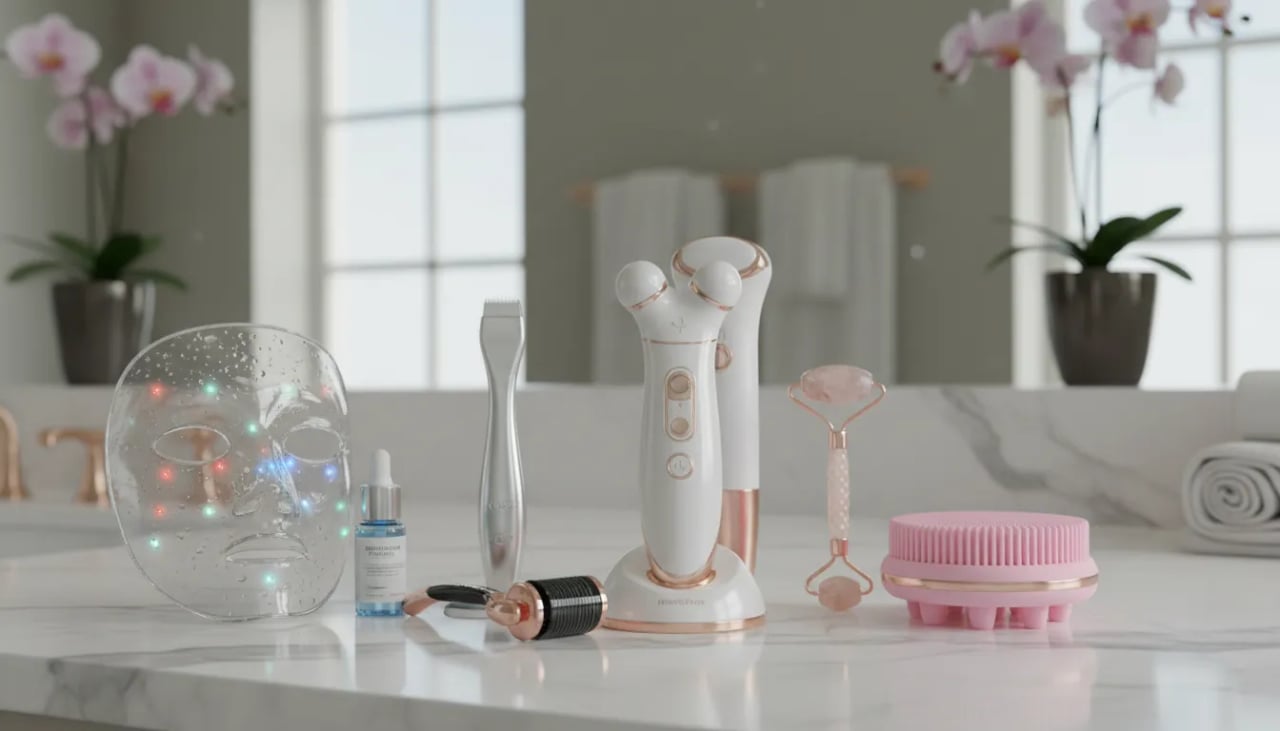
The standout LED mask for me was the ONFACE LED Mask. The spec that kept coming up in demos was its sheer density: 3,770 micro red LEDs. That matters because more evenly distributed light can mean fewer “hot spots,” better coverage, and more consistent sessions. In a few live demos, I could see immediate improvements in skin condition—mainly a calmer look and a fresher tone—right after use.
Ava Chen, Beauty Tech Editor: "Dense micro-LED arrays are changing treatment times—shorter sessions, similar boost."
This matches the bigger 2026 skincare trend I saw everywhere: red light therapy, but simplified. Less fiddling, more repeatable results.
Hyper Rejuvenating Eye Patch: AI diagnostics + flexible LED therapy
Where masks treat the whole face, the most interesting targeted option was the Hyper Rejuvenating Eye Patch. It’s a rejuvenating patch concept that combines AI diagnostics, custom ingredients, and flexible LED therapy to focus on under-eye concerns like puffiness, dullness, and fine lines. I like the direction: instead of guessing, the patch aims to adjust treatment to what your under-eye area actually needs that day.
My practical at-home rotation (less daily effort)
If you want results without a heavy routine, I’d rotate tools rather than stack everything daily:
Weekly LED light therapy sessions with an LED mask (think consistency over intensity).
Targeted rejuvenating patch use for under-eyes or nasolabial folds on “tired face” days.
Keep the rest simple: cleanse, moisturize, and sunscreen—then let the device time do the work.
Needle-free delivery and the promise of SkinBoosters Jet
At CES 2026, I saw plenty of beauty devices claiming “next-level” results. But the demo that made me stop mid-walk was L’Oréal’s SkinBoosters Jet. It’s built around needle-free delivery using micro-atomization—basically turning a cosmetic formula into an ultra-fine stream that can be applied with precision, without a needle. The pitch is bold: pain-free cosmetic delivery with medical-grade results. And in person, it didn’t feel like a gimmick.
What makes SkinBoosters Jet different from typical facial treatment tools
Most at-home tools I’ve tested rely on energy-based tech—radiofrequency, LED light, ultrasound, microcurrent—to support cellular regeneration, stimulate collagen, and improve firmness. Those can be great for a facial treatment, especially when they’re safe, non-invasive, and adjustable. SkinBoosters Jet adds a new layer: it’s not only about stimulating skin, it’s about delivering actives in a controlled way through needle-free injection-style micro-atomization.
Why needle-free injection matters for real people
I keep thinking about how many people want the “injectable look” but avoid needles. A reliable needle-free injection approach could lower that fear barrier and make upkeep feel more like routine skincare than a big appointment. It also fits the bigger CES trend: non-invasive, at-home devices that lean into personalised skincare and precision—tools that help you target wrinkles, dark spots, acne, or loss of elasticity without guessing.
Accessibility: easier maintenance at home between professional visits
Comfort: less anxiety for needle-averse users
Customization: supports more personalised skincare routines
My quick demo: mist, not sting
I volunteered for a short demo, expecting at least a snap or sting. Instead, I felt a gentle mist and light pressure—no pain, no flinch. That lived experience made needle-free delivery feel real, not buzzwordy.
Prof. Michael Torres, Cosmetic Scientist: "Needle-free micro-atomization can broaden access, but formulation stability is key for efficacy."
That last point matters: the device can be impressive, but the formula has to stay stable and effective through the delivery process for results to truly match the hype.
Low-heat styling, smart nails, and other wellness innovations
Infrared technology makes hair styling feel safer
Walking CES 2026, I noticed a clear shift: beauty devices aren’t just louder or flashier—they’re smarter, gentler, and more personal. The best example is L’Oréal’s Light Straight + Multi-styler, a light styler concept that uses infrared technology for low-temperature results, with a launch planned for 2027. That long runway matters. It shows how brands now use CES to prove the science, refine safety, and build real-world performance before a device hits my bathroom counter.
Ethan Morales, Product Manager (Hair Tech): "Low-temp infrared styling preserves hair health without sacrificing results."
For me, the promise of infrared hair styling is simple: less heat damage without giving up smoothness or shape. Instead of blasting hair with extreme surface heat, infrared energy aims to warm more evenly. This is where smart styling starts to feel like a wellness upgrade, not just another tool for hair styling.
Smart styling is also about better decisions
What I’m seeing across devices is a move toward precision—tools that adjust to me, not the other way around. In practice, that means:
Lower-temp routines that still deliver straightening and multi-style looks
More consistent results across different hair sections
Personalized settings that reduce over-processing
Wellness innovations move diagnostics into daily routines
Another standout: the Balance AI Rejuvenation Shower System. It uses near-infrared sensors to analyze hydration, oil, elasticity, and pigmentation during the shower. I love this direction because it turns a routine moment into hands-free skin check-ins—exactly the kind of “quiet” tech that can support predictive skincare over time.
Smart nails hint at the next crossover category
CES 2026 also made me think about smart nails as the next frontier. I’m not just talking about LED curing. The idea is mani/pedi tools that guide pressure, timing, and hygiene, or even track nail and cuticle condition as part of broader wellness innovations. It’s the same theme everywhere: non-invasive, at-home devices built on personalization, precision diagnostics, and safer results.
Reality check: safety, efficacy, and the dermatologist’s role
Non-invasive skincare is booming—but proof still matters
CES 2026 made one thing clear: non-invasive skincare is no longer a niche. Devices using LED, ultrasound, microcurrent, and heat-based tech are everywhere, and the best ones really can support healthier-looking skin by encouraging collagen, improving firmness, and smoothing texture. But I’m picky about claims. If a brand promises wrinkle reduction or “dark spot erasing,” I want to see clinical studies, not just before-and-after photos with different lighting.
This is where the new wave of personalization helps. Many launches lean into precision diagnostics and predictive skincare—think AI-powered routines that adjust intensity, timing, and even product pairing. That’s exciting, especially as 2026 trends push simplified at-home treatments (like red light therapy) over complicated multi-step regimens. Still, personalization doesn’t replace validation. If a device claims it can do pigmentation assessment, I look for data on accuracy, skin tone range, and how it performs over time.
What I trust for maintenance: microcurrent, radiofrequency, and ultrasound
A consistent microcurrent facial can be a nice “maintenance lift” for some people, especially when used safely and regularly. Radiofrequency rejuvenation can also support firmness, but heat is not something I take lightly—settings, skin type, and frequency matter. And for ultrasound tools, I always read multiple ultrasound reviews and check whether the brand explains depth, safety limits, and who should avoid it.
When I stop DIY and call a dermatologist
If acne is persistent, if pigmentation changes suddenly, or if I notice dramatic elasticity loss, I don’t try to “device my way out of it.” At-home tools are great for upkeep, not diagnosis or treatment of medical conditions.
Dr. Priya Patel, Dermatologist: "At-home devices complement clinical care—they're great for maintenance, but some conditions need hands-on medical treatment."
My tiny rant: marketing blur is real
I love beauty tech, but “medical-grade” gets tossed around like confetti. My rule: ask for evidence, check contraindications, and when in doubt, bring the device name to your dermatologist. That’s how CES 2026 finally feels like progress—better tools, smarter routines, and a clearer line between home maintenance and real medical care.