
(Discover many other contents on: NOWO.ONE and NOWO Publishing)
I care about creatine because I train for strength and short, brutal bursts—heavy sets, sprints, and circuits where a little extra output matters. Creatine is a natural compound found mainly in muscles and the brain, made up of three amino acids: arginine, glycine, and methionine. It is obtained through certain foods, such as meat and fish, but can also be taken as a supplement. Its main function is to help produce rapid energy (ATP) during short, intense efforts, such as weight training or sprinting. For this reason, it is very popular among athletes, as it can help increase strength, muscle power, and improve physical performance. Additionally, it may support muscle recovery and the growth of lean muscle mass.
Did You Know?
Creatine is one of the most studied sports supplements, and creatine monohydrate is commonly used because it’s inexpensive and well-supported by research for high-intensity performance.
Source: International Society of Sports Nutrition (ISSN) position stand (update statements widely cited)
Next I’ll cover how creatine works inside the muscle, how much you can realistically get from steak or salmon, and what “creatine monohydrate” vs “Creapure®” really means. I’ll also share dosing and timing basics, real-world benefits, safety notes, and practical tips (mixing with water, consistency, and what to expect on the scale).
What creatine is and how it works
Creatine is one of those “small molecule, big impact” compounds in sports nutrition. Creatine is a natural compound found mainly in muscles and the brain, made up of three amino acids: arginine, glycine, and methionine. It is obtained through certain foods, such as meat and fish, but can also be taken as a supplement. Its main function is to help produce rapid energy (ATP) during short, intense efforts, such as weight training or sprinting. For this reason, it is very popular among athletes, as it can help increase strength, muscle power, and improve physical performance. Additionally, it may support muscle recovery and the growth of lean muscle mass.
When I hear “energy,” I think caffeine or carbs—but creatine is different. It doesn’t “stimulate” me and it isn’t a fuel source like glucose. Instead, it increases my ability to recycle ATP quickly when I’m pushing hard.
Where creatine lives in my body
Most creatine is stored in skeletal muscle, with a smaller (but meaningful) amount in the brain. In muscle, it exists in two main forms: free creatine and phosphocreatine (often abbreviated PCr). PCr is the “charged” form—like a backup battery my body can tap instantly.
This storage location explains a lot about who feels the effects most. If my training includes heavy sets, short sprints, or explosive work (think barbell squats, prowler pushes, rowing starts, or repeated jumps), I’m leaning heavily on the muscle systems where creatine is actually kept.
How it works: the phosphocreatine system (ATP recycling)
ATP (adenosine triphosphate) is the immediate energy currency my muscles spend to contract. The problem is I don’t store much ATP at any one time, so during an all-out effort it drops fast. The phosphocreatine system is my body’s rapid-response method to regenerate ATP from ADP (adenosine diphosphate) right when demand spikes.
Here’s the key reaction, driven by the enzyme creatine kinase: phosphocreatine donates a phosphate to ADP, turning it back into ATP. This happens extremely fast, which is why it matters most for short, intense bouts—typically the first several seconds of maximal effort and repeated high-power bursts with limited rest.
Why that matters in real training
Practically, this is why creatine tends to show up as “one more rep,” slightly higher bar speed, or the ability to repeat hard efforts with less drop-off. It’s not a miracle for long, steady cardio because the phosphocreatine system is a short-duration, high-power buffer—not a minutes-long fuel tank.
Heavy lifting: more high-quality reps near the end of a set (e.g., bench press, deadlift).
Sprinting/explosiveness: better repeatability in short bursts (e.g., 10–30 second intervals).
Team sports: helps when play is stop-and-go (e.g., basketball or soccer accelerations).
If I’m choosing a supplement with the clearest “mechanism-to-gym” connection, creatine monohydrate is popular because it directly supports this ATP buffering system by increasing my muscle creatine and phosphocreatine availability over time.
Dietary sources and how much they provide
Creatine occurs naturally in animal muscle, so the most reliable dietary sources are meat and fish. In real food terms, you’re usually looking at roughly 0.3–0.7 g of creatine per 100 g for common meats and many fish, with some fish (like herring) tending to run higher. That’s why people who eat mostly plant-based often start with lower baseline creatine stores.
Common foods with approximate creatine per 100 g
Beef: ~0.3–0.7 g (often estimated around ~0.45 g)
Pork: ~0.3–0.6 g (often estimated around ~0.40 g)
Salmon: ~0.3–0.7 g (often estimated around ~0.45 g)
Herring: ~0.6–1.0+ g (commonly one of the higher options)
Numbers swing based on species, cut, freshness, and lab methods. Cooking can also reduce creatine somewhat because it can break down and drip out with juices, so treat food estimates as “ballpark,” not precise dosing like a supplement label.
Food vs supplement: what “5 g” looks like on a plate
A typical 5 g daily dose of creatine monohydrate (for example, Optimum Nutrition Micronized Creatine or Thorne Creatine) can be hard to replicate with food alone. Using the estimates above, you’d need roughly ~550–1,250 g of meat/fish depending on the choice and exact content; herring is closer to the “less food” end, while beef/pork/salmon usually take more.
Practical guidance by diet pattern
Omnivore: If I already eat meat most days, I’m likely getting some creatine, but a consistent 3–5 g supplement is simpler than trying to “dose” it via large portions.
Pescatarian: I can prioritize higher-creatine fish (herring, salmon) a few times per week, but a modest supplement can still be the most predictable option.
Vegetarian/vegan: Foods won’t meaningfully provide creatine, so a creatine monohydrate powder (Creapure-based products are common) is the straightforward way to match studied intakes.
Supplementation: types, dosing, and timing
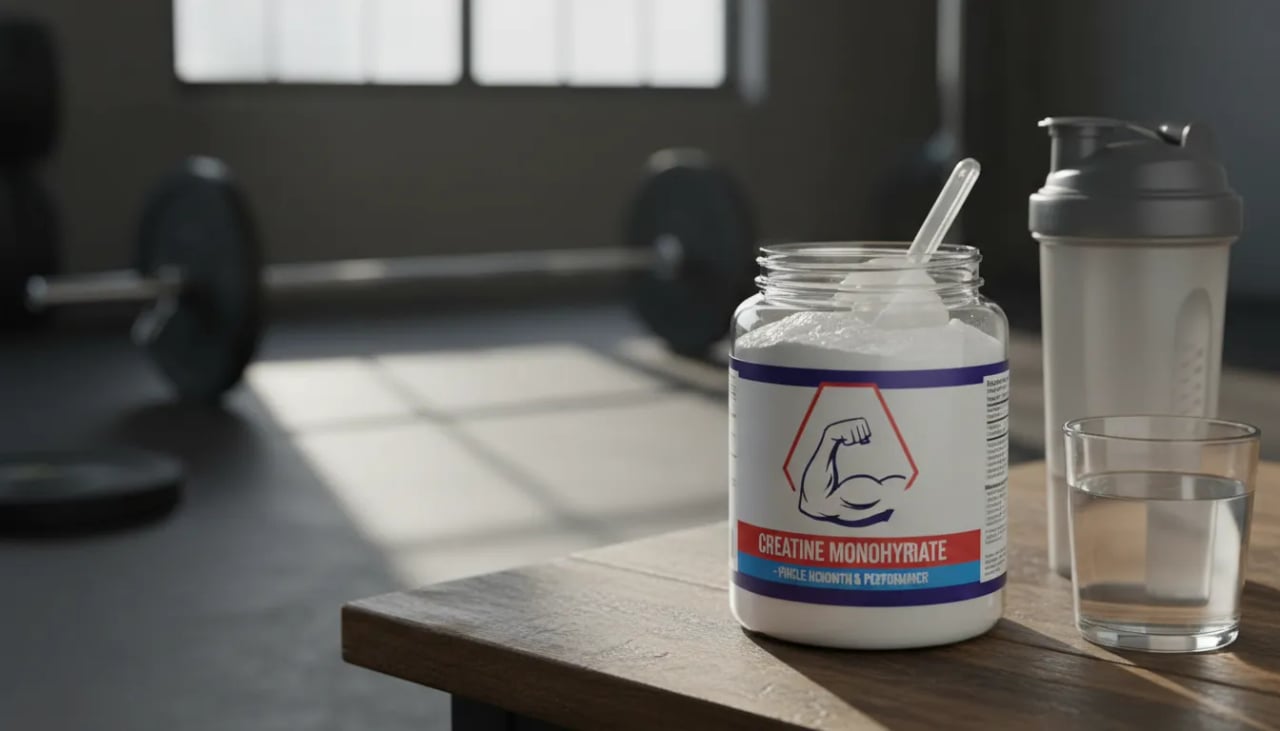
If I’m going to supplement creatine, I want the version with the strongest track record and the simplest dosing. For most people, that’s creatine monohydrate—especially well-known raw-material standards like Creapure® when I’m shopping for a powder. It’s inexpensive per gram, mixes easily, and it’s the form most performance research is built on.
Types: what I’d actually buy
Creatine monohydrate is the gold standard. I look for plain “creatine monohydrate” with no proprietary blends, ideally third-party tested (brands like Thorne Creatine or Optimum Nutrition Micronized Creatine are common examples). Micronized just means finer powder; it can help it dissolve, but it’s still monohydrate.
Creatine hydrochloride (HCl) (for example, Kaged Creatine HCl) is marketed as easier on digestion and more soluble. Some people do find it gentler, but the evidence base is smaller than monohydrate, and the cost per effective dose is usually higher.
Buffered forms (often sold as Kre-Alkalyn®) are pitched as “better absorbed” or “no bloating.” Practically, I treat them as optional: they tend to cost more, and I don’t expect meaningful advantages over monohydrate for most lifters.
Dosing models: loading vs steady daily
There are two proven ways I can raise muscle creatine: a faster “loading” ramp or a slower, simpler daily dose. Both end up in a similar place—the difference is how quickly my muscles get there.
Loading is typically 20 g/day for 5–7 days, split into smaller doses (like 4 × 5 g). This saturates muscle creatine quickly—often close to “full” within about a week. The tradeoff is that bigger doses can cause stomach upset for some people, so splitting it matters.
No loading is just 3–5 g/day from day one. It’s easier, often better tolerated, and still reaches similar saturation—just slower, typically over about 3–4 weeks. If I care more about adherence than speed, this is my default.
Timing: pre vs post-workout (and what matters more)
I don’t stress pre- versus post-workout timing. The biggest driver is daily consistency, because creatine works by building and maintaining higher muscle stores, not by giving a one-hour “boost” like caffeine.
If I want an easy rule: on training days, I’ll take it with my post-workout shake (maybe with something like Optimum Nutrition Gold Standard Whey), and on rest days I’ll take it with breakfast. If I train early and forget later, pre-workout with water is perfectly fine.
Hydration and tolerance: keeping it easy on my stomach
I split doses during a loading phase (5 g at a time) to reduce GI issues.
I mix it thoroughly and drink an extra glass of water with it, then hydrate normally the rest of the day.
If I feel bloated or cramped, I drop to 3 g/day or divide 5 g into 2–3 g twice daily.
Benefits: performance, recovery, and muscle growth
Creatine pays off most when my training depends on short, hard bursts: heavy sets, repeated sprints, jumps, or hard intervals. It works by increasing phosphocreatine in muscle, which helps recycle ATP faster, so I can squeeze out an extra rep, hold power a bit longer, or repeat efforts with less drop-off. That “small edge” compounds over weeks because I’m able to train at a higher quality.
Strength, power, and sprint performance
The most consistent upside is improved performance in high-intensity, short-duration work. In practical terms, creatine monohydrate (for example, Optimum Nutrition Micronized Creatine or Thorne Creatine) tends to show up as better bar speed on sets of 3–8, slightly higher total volume, and improved repeat-sprint ability (think 10–30 second efforts with short rest). I notice it most on big lifts like squats and presses, and in sports like soccer, basketball, hockey, rugby, CrossFit-style training, and track sprints.
Recovery and lean mass gains
Creatine won’t replace sleep, protein, or smart programming, but it can support recovery by helping me maintain output across sessions. When I can do more high-quality work, I create a stronger muscle-building stimulus. Many people also see a quick increase on the scale early on—often from additional water stored inside muscle cells—which can make muscles look “fuller” and may help training feel better. Over time, the bigger win is lean mass gains driven by increased training volume and consistency.
Who benefits most
Athletes in short-intense sports: sprinters, field/court sport athletes, and fighters who repeat high-power efforts.
Strength trainees: powerlifting, bodybuilding, and anyone progressing on compound lifts who wants more high-quality volume.
Vegetarians/vegans: because dietary creatine from meat and fish is low, baseline muscle creatine can be lower, so the “room to improve” is often bigger.
Safety, side effects, and common misconceptions
Creatine monohydrate is one of the most studied sports supplements, and in healthy people it has a strong safety record—even with long-term, daily use. The big worry is kidneys: creatine can raise blood creatinine (a breakdown marker), but research in healthy adults generally doesn’t show impaired kidney function at recommended doses. If I have kidney disease, uncontrolled hypertension, or I’m frequently using nephrotoxic meds like high-dose NSAIDs, I treat creatine like any supplement and check with a clinician.
Common side effects (and how I reduce them)
Water retention: early scale weight is usually water stored in muscle, not “fat gain.” I keep dose steady (3–5 g) instead of yo-yo loading.
GI upset: I split doses, dissolve fully, and take it with food. Products like Optimum Nutrition Micronized Creatine mix easier than gritty powders.
Myths I ignore
“Creatine is a steroid”: it’s not; it’s a naturally occurring compound found in muscle and in foods like meat and fish.
“Unsafe for teens”: not automatically, but it’s a higher-stakes decision—Loop in a pediatrician or a sports dietitian.
“Permanent bloating”: the “puffy” look is usually temporary water shifts, and many people don’t notice it at all.
Frequently Asked Questions
Creatine is a natural compound found mainly in muscles, so it’s normal to have safety and “what will I look like?” questions before I start supplementing. I stick to creatine monohydrate because it’s the most studied form and easy to dose.
Creatine FAQ (Quick Answers)
Does creatine damage the kidneys or liver in healthy people? ▼
How much creatine should I take, and do I need a loading phase? ▼
Do vegetarians get more benefit from supplementation? ▼
Will creatine make me gain fat or look puffy? ▼
Is creatine safe for teenagers and older adults? ▼
If I want fewer surprises, I keep my routine simple: one daily dose, consistent hydration, and I buy from third-party tested lines (NSF Certified for Sport® or Informed Sport). If I’m getting labs, I note “creatine monohydrate” on the intake form so elevated creatinine isn’t misread.
Conclusion
Creatine is a natural compound found mainly in muscles and the brain, made up of three amino acids: arginine, glycine, and methionine. It is obtained through certain foods, such as meat and fish, but can also be taken as a supplement. Its main function is to help produce rapid energy (ATP) during short, intense efforts, such as weight training or sprinting. For this reason, it is very popular among athletes, as it can help increase strength, muscle power, and improve physical performance. Additionally, it may support muscle recovery and the growth of lean muscle mass.
🎯 Key takeaways
- → Creatine helps recycle ATP for short, intense efforts—supporting strength, power, and training quality.
- → A simple start: creatine monohydrate (e.g., Optimum Nutrition Micronized or Thorne), 3–5 g daily; optional loading 20 g/day for 5–7 days.
- → Check in with a clinician or sports dietitian if pregnant, under 18, have kidney disease, take nephrotoxic meds, or have unexplained cramps/GI issues.
My next step: pick a plain, third-party-tested creatine monohydrate (Thorne or Optimum Nutrition), take 3–5 g daily with water, and track workouts for 4 weeks. If I have kidney concerns, take meds like NSAIDs frequently, or get persistent GI upset, I’ll consult my clinician or a sports dietitian before pushing the dose.