


(Discover many other contents on: NOWO.ONE and NOWO Publishing)
I remember stuffing a tangle of chargers into a backpack for a business trip and swearing there had to be a smarter way. That irritation nudged me into collecting tiny, life-saving tech accessories—wireless headphones, fast chargers, power banks, a smartwatch that actually lasts, and a keyboard I can use on the sofa. After roaming CES 2026 write-ups and catalogs, I realized these small things aren't just convenient—they hint at where tech is going: smarter, smaller, and quietly AI-powered.
1. Pocket Essentials: Chargers, Power Banks, and Fast Fixes
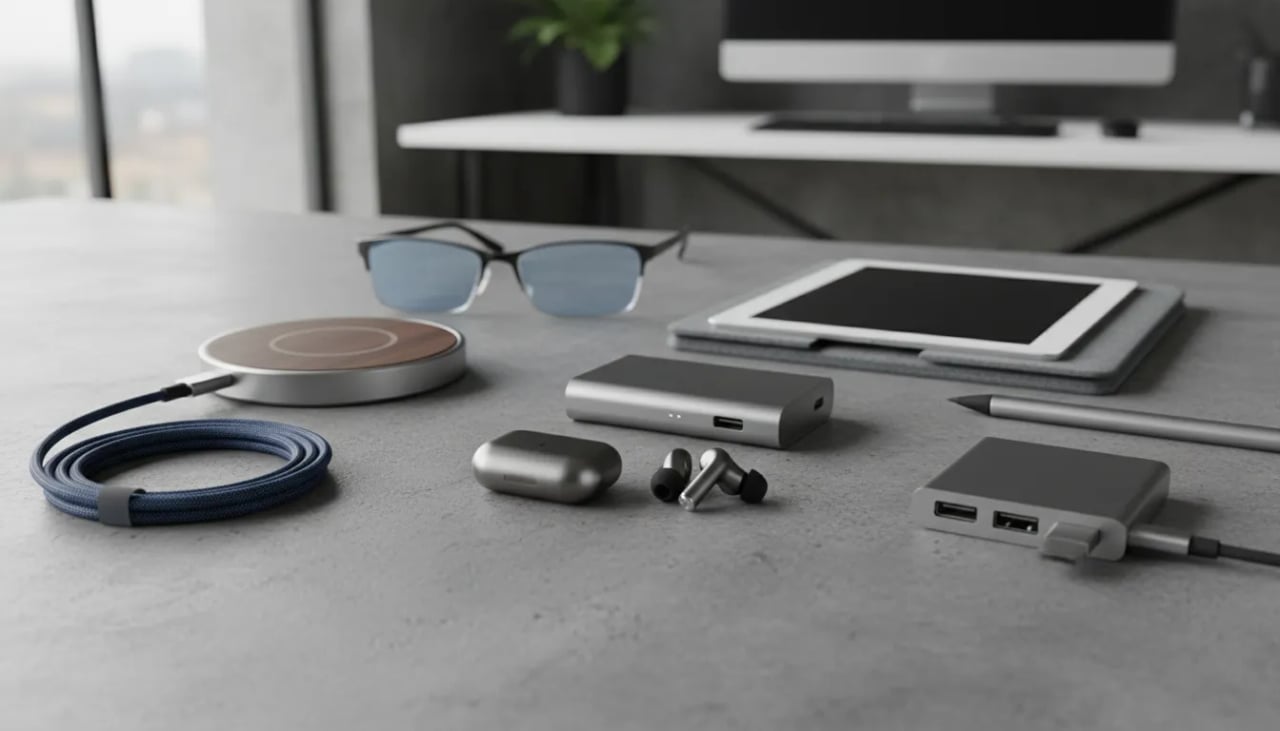
I never leave home without Fast Chargers and a 20,000 mAh Power Bank. I learned that the hard way last winter: my phone died while I was waiting for a ride in the cold, and my digital ticket, map, and messages were all locked behind a black screen. Since then, “pocket power” has been my simplest daily upgrade—small gear that keeps my phone, tablet, and laptop useful.
Fast Chargers (30W–100W): my everyday safety net
For most phones, a 30W USB-C charger is plenty. If I’m charging a tablet or a light laptop, I look closer to 65W–100W. The key is USB-C PD (Power Delivery), which helps devices and chargers “agree” on safe, fast speeds.
Wireless Charging and the new Wireless Station trend
When I’m at a desk, Wireless Charging is my favorite “fast fix.” Drop-and-go beats hunting for cables. And after seeing the Wireless Station wave at CES 2026, I’m sold on multi-device docks for shared desks—one spot for phone, earbuds, and watch, with fewer tangled cords.
Alex Kim, CES Analyst: "CES 2026 emphasized smarter charging: more wattage, smarter negotiation, and local AI handling energy flows."
That local AI angle matters because battery life and charging speed are still top priorities, and smarter power management can reduce heat and wasted energy.
Quick buying tips I follow
Check wattage: match your device needs (phones ~30W, laptops often 65W+).
Look for USB-C PD: better compatibility across phones, tablets, and computers.
Choose pass-through charging: charge the power bank and your device at the same time—great for travel.
Set expectations: a 20,000 mAh Power Bank is still essential for commuters and travelers.
2. Wearable Tech & Health: Smartwatches, Smart Rings, and Neural Earbuds
Why I downsized my Wearable Tech
I used to wear a big smartwatch that did everything—except last. After a few too many “low power” warnings, I switched to a Pebble Round-style watch. The Pebble Round 2 vibe is what I wanted: simpler notifications, a clean look, and multi-day Battery Life that fits real life. I still get the basics—calls, messages, calendar taps—without feeling like I’m carrying a tiny phone on my wrist.
The Smart Ring advantage for quiet Health Monitoring
When I need something even more low-key, a Smart Ring makes sense. The Core Devices Index 01 (2026) promises 24/7 health tracking plus discreet alerts—perfect for meetings where a buzzing wrist is too obvious. This kind of Health Tech feels like it’s built for “always on” life: sleep, recovery, and daily trends without changing how I dress or work.
Dr. Maya Singh, Wearables Researcher: "The shift at CES 2026 was toward always-on health sensing paired with local AI—privacy and battery life matter."
Neural Earbuds, sweat patches, and the new places health data shows up
CES 2026 also made it clear that Health Monitoring is spreading beyond wrists and fingers. Neural Earbuds like Naqi Neural Earbuds hint at audio that doubles as control and sensing, with more local AI for real-time insights without sending everything to the cloud. And it’s not just earbuds—smart Sweat Patch ideas, plus unexpected products like the Throne toilet computer and smart menstrual pads, show how broad wearable-style health tracking is becoming.
Pebble Round-style watch: simpler alerts + strong Battery Life
Index 01 Smart Ring: 24/7 tracking + discreet notifications
Neural Earbuds & Sweat Patch: health data meets everyday accessories
3. Audio and Focus: Wireless Headphones, Active Noise, and Ambient Designs
Wireless Earbuds for deep work (my default)
When I need a clean, quiet bubble, I reach for Wireless Earbuds with Active Noise features and strong Noise Cancellation. They’re my go-to for short, focused work sprints: writing, editing, or knocking out admin tasks without getting pulled into every nearby conversation. Good ANC also makes calls clearer, especially in cafés or shared offices.
Ambient awareness: open-ear designs that keep me polite
Sometimes silence isn’t the goal. If I’m walking, commuting, or working where I need to hear my name, open-ear designs feel safer and more social. CES 2026 highlighted this shift, including the Sony LinkBuds Clip style of open-ear wireless audio that lets outside sound in while still giving me music and podcasts.
CES 2026 trends: smarter sound and neural ideas
Audio at CES 2026 wasn’t just “louder” or “smaller.” It leaned into adaptive listening and new control concepts like Naqi Neural Earbuds, a neural control idea that hints at hands-free input. I also noticed more talk about AI Support for sound: earbuds that learn my preferences and adjust EQ and Noise Cancellation based on where I am. As Jared Lopez, Audio Product Director, put it:
“CES 2026 pushed smarter audio—AI noise profiles and open-ear designs for situational awareness.”
My quick buying checklist (what actually matters)
ANC quality: does it reduce voices and traffic, not just hum?
Battery life: typical ANC earbuds run 6–30+ hours with case.
Fit: comfort beats specs; try tips or wings if they slip.
Open-ear vs. sealed: choose based on commute safety and office etiquette.
Smart Connectivity: fast pairing, multipoint switching, and stable calls.
4. Unusual Stuff I Fell For: Smart Glasses, Creaseless Foldables, and Emotional Pets
Smart Glasses that made me feel (slightly) like Iron Man
At CES 2026 (January 2026), Smart Glasses stopped feeling like a weird demo and started feeling… normal. I tried a gaming-focused pair in the Asus ROG Xreal R1 lane—ROG Xreal-style, light on my face, and surprisingly easy to use. I could watch hands-free media, pin a small screen in my view, and grab quick AR clips without pulling out my phone. It also clicked with the “AI wearable as an external brain” idea: the glasses don’t replace my devices, they extend them.
Creaseless Foldables and Foldable Laptops: new shapes, new habits
I also got pulled into the buzz around Creaseless Foldables. Samsung’s creaseless foldable display talk—and the 2026 shipping rumblings—made me rethink what “protective case” even means. If the screen doesn’t have that deep line, I’m less worried about pressure points, but more careful about grit and tight pockets.
And then there are Foldable Laptops and rollable laptops shipping 2026. These form factors feel like the next durable wave: bigger screens when I need them, smaller footprints when I don’t. The accessory story shifts too—slim sleeves, softer linings, and stands that don’t fight the hinge.
Emotional Pets (and an exoskeleton) changed my idea of “accessory”
I laughed when I saw Emotional Pets at CES, then I paused. They’re not just utility like chargers or earbuds; they’re comfort tech. Same with the Hypershell X exoskeleton mention—suddenly accessories are about energy, mood, and support.
Lena Ortega, Consumer Tech Writer: “CES 2026 blurred lines between gadgets and companions—smart glasses and empathy tech stood out.”
Smart Glasses: hands-free screens, gaming, lightweight AR
Creaseless Foldables: fewer crease worries, more pocket care
Emotional Pets: lifestyle and empathy tech joins the accessory list
5. Quick Buying Guide: What I Actually Recommend
When I buy Tech Gadgets, I start with one rule: match the accessory to my ecosystem (Apple, Android, or Windows). Compatibility saves headaches—pairing, drivers, and even Smart Home control can break if you mix the wrong standards.
Maya Patel, Product Strategist: "Buy for daily friction reduction—if it doesn't simplify one routine, skip it."
My 3 filters: compatibility, battery life, and local AI
Compatibility first: check USB-C vs Lightning, Bluetooth versions, and app support on your OS.
Battery life over novelty: I’d rather have earbuds that last all week than a feature I use once.
Local AI matters: CES 2026 trends point to better integration, smarter power management, and more on-device AI—faster responses and better privacy than cloud-only tricks.
Top picks by need (what I’d buy again)
Commuting: noise-cancelling wireless headphones/earbuds (I like the Soundcore Work style for calls) + a reliable power bank.
Remote work: a solid Bluetooth Keyboard + fast charger. Add a Productivity Mouse if you live in spreadsheets—quiet clicks and multi-device switching reduce friction fast.
Travel: smart ring (quick alerts without pulling out my phone) + compact charger with smart power sharing.
Small extras I only recommend if they solve a real pain
Protective cases: durable materials, good grip, and MagSafe/Qi alignment if you use wireless charging.
Bluetooth keyboard and mice: pick ones that remember 2–3 devices for laptop + tablet workflows.
Stream Deck: worth it if you repeat the same shortcuts all day (meetings, editing, smart scenes).
Smart Home compatibility: look for Matter support and stable connectivity before buying “smart” anything.
Wild Cards: Two Strange Scenarios I Couldn't Resist
Scenario 1: The “Everything” wearable (and my near-ring payment)
What if my smartwatch could act as a credit card, a house key, and an emotional thermometer? I tried to live in that “what if” for one afternoon. At a coffee shop, I tapped my wrist to pay, then reached for the door… and almost paid again with my ring out of habit. It felt silly, but also weirdly normal—like the future was already leaking into my routine.
CES 2026 leaned hard into this kind of empathy tech, and it made me think beyond fast chargers and wireless headphones. If a wearable can read stress, it can also nudge me to take a break, call a friend, or stop doom-scrolling. That’s where Emotional Pets caught my eye: not a “pet” in the cute sense, but a small companion device that reacts to your mood and tries to calm you down. Strange? Yes. Useful? Maybe.
Scenario 2: Health tech that’s personal… and a little awkward
Then there were the CES 2026 oddities I couldn’t stop thinking about: the Throne toilet computer and Smart Menstrual Pads. Both sound like jokes until you remember what accessories do best: they make daily life easier, cleaner, and more connected. If a pad can track patterns or a toilet can flag hydration changes, that’s not “extra”—that’s quiet prevention.
Still, I treat accessories like spices. A smart ring is a pinch of cinnamon; a full smartwatch is the curry. Both are tasty, but context matters. I don’t want every moment measured—just the moments that help.
Rafi Torres, Trend Forecaster: "The fringe ideas at CES often become mainstream in unexpected ways—watch the oddities."
That’s my takeaway: these wild cards aren’t must-buys today, but they’re great hypotheticals. They help me decide what I’d actually welcome on my wrist, in my bag, or in my life.