
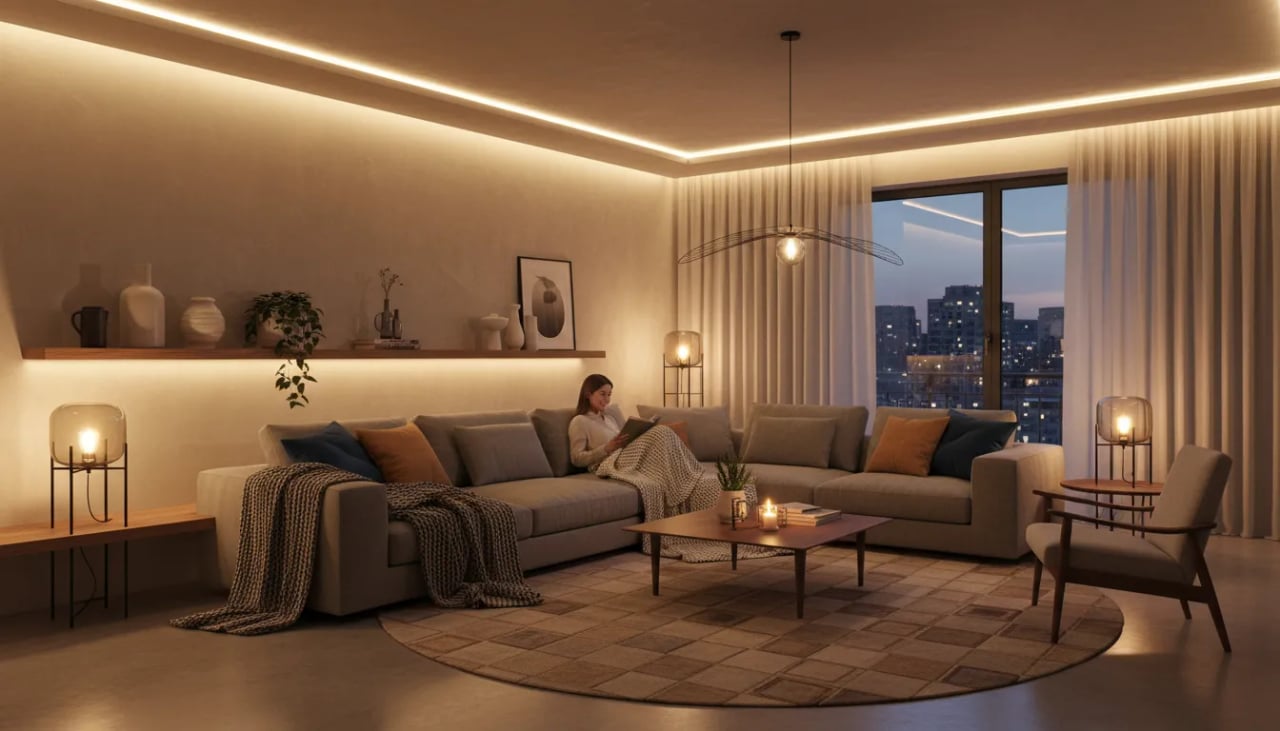



(Discover many other contents on: NOWO.ONE and NOWO Publishing)
I still remember the first evening I swapped the harsh overhead light for a warm cove glow—suddenly the living room felt calmer, movies were cozier, and I actually wanted to linger. That small change led me deep into a rabbit hole of bulbs, diffusers, and smart scenes. This post is the travel journal of that rabbit hole: practical tips, slightly opinionated takes, and a few experiments you can try tonight.
Why Ambient Lighting Matters: Mood, Sleep, and Comfort
Ambient lighting sets the tone for how I feel at home
When I think about comfort, I don’t start with furniture—I start with ambient lighting. Soft, diffuse light makes my home feel warm and inviting, especially after a long day. It’s the kind of glow that fits anywhere, from my living room to my bedroom, and it instantly makes the space feel calmer. I notice it most during simple moments: reading a few pages, watching a movie, or just sitting quietly with a cup of tea.
Soft light reduces strain and supports better rest
Harsh overhead light makes my eyes feel tired fast. But when I switch to gentle, indirect relaxation lighting, my shoulders drop and my focus feels easier. There’s also a sleep angle here. Research on circadian rhythms suggests that lower, warmer light in the evening can help the body ease toward sleep by supporting melatonin production. It’s not magic, but it’s a helpful nudge—like telling my brain, “We’re done for the day.”
The lamp that replaced my pre-bed phone scroll
I used to do the classic thing: lie on the couch and scroll my phone until I felt sleepy. Then I added a simple living room lamp with adjustable tones. I started setting it to a warm, dim level about an hour before bed. That one change made it easier to put my phone down, because the room itself felt like a cue to slow down. The space became a small haven—comfortable, quiet, and honestly more “me.”
Human-centric and circadian lighting: warm at night, cool by day
One of the big 2026 trends I keep seeing (including in the Lutron trend report 2026) is human-centric design—lighting that works with our bodies, not against them. Circadian lighting is a big part of that: cooler, brighter light earlier in the day, and warmer, softer light at night. It’s also tied to biophilic ideas, where we try to echo natural light patterns indoors.
“Lighting that respects our daily rhythms makes rooms feel like a home, not a showroom.” — Dr. Laura Bennett, Lighting Researcher
Practical takeaway: match light to the moment
Evening rooms: use warm, dimmable relaxation lighting for winding down.
Daytime: prioritize natural light and add cooler tones if a room feels dark.
Flexibility: choose tunable LEDs so one fixture can shift from “focus” to “rest.”
Design Tricks: Layered, Indirect, and Cove Lighting
Layered lighting: ambient + task + accent = comfort
When I want a room to feel truly welcoming, I don’t rely on one bright ceiling light. I use layered lighting, which simply means mixing three types of light: ambient for overall glow, task for what I’m doing, and accent for mood and texture. This balance helps cut down harsh shadows and makes the space feel softer and more “finished.” It also lets me adjust tones—warm for relaxing, slightly cooler for focus—so the lighting fits everything from reading to movie nights.
Why indirect lighting and cove lighting feel so soft
Indirect lighting works by bouncing light off ceilings or walls instead of shining straight into my eyes. That bounce creates diffuse lighting, which is easier on the eyes—especially during screen time or when I’m winding down after a long day. Cove lighting is one of my favorite ways to do this. A cove is a ledge or recess near the ceiling that hides the light source, so the room glows without glare.
“A well-placed cove can make a room breathe.” — Michael Steffan, Interior Lighting Designer
Placement tips I use (ceilings, shelves, and floors)
Uplighting for ceilings: Aim light upward from a wall sconce or hidden strip to lift the whole room.
Shelf accenting: Add a soft line of light under shelves to highlight books, art, or wood grain.
Toe-kick strips: Place led strips under cabinets or a floating vanity for depth and a gentle night glow.
LED strips + diffusers for even illumination (a 2026 favorite)
One 2026 idea I keep seeing—and love—is led strips tucked into cove lighting channels for smooth, even illumination and visual depth. The trick is using a diffuser (a frosted cover) so the dots disappear and the light looks like one clean line. I also choose adjustable tones so the same setup can feel cozy at night and clear in the morning.
Quick experiment: replace one pendant with three indirect sources
Turn off the central pendant for one evening.
Use three indirect sources: a floor lamp aimed at the ceiling, a shelf light, and a toe-kick or TV-backlight strip.
Notice how the room feels calmer, with less glare and fewer hard shadows.
Tech Choices: Dimmable LEDs, Tunable White, and Fixtures
When I started upgrading my ambient lights for the home, I wanted that warm, inviting feel that makes it easy to relax after a long day. I also wanted lighting that could shift with my routine—bright enough for reading, soft enough for movies, and calm enough for a peaceful moment.
Why I swapped to dimmable led and modern led bulbs
I replaced my old incandescent bulbs with dimmable LED bulbs because they give me two wins at once: energy savings and real mood flexibility. I can keep the room gently lit for comfort, then raise the level when I’m cleaning or hosting friends. That kind of brightness control is what makes ambient lighting feel personal instead of “one setting fits all.”
“Dimmable LEDs are the single most useful upgrade I recommend to clients.” — Sophia Marcella, Residential Lighting Consultant
Tunable LEDs and the 2026 push for day-night comfort
One of my favorite upgrades has been tunable leds (often called tunable white). This is a highlighted 2026 idea because it supports human-centric lighting—matching light to how we live. During the day, I lean into cooler whites that feel clean and alert. In the evening, I slide toward warmer tones that feel cozy and help my body wind down, which can be friendlier to a natural circadian rhythm.
Daytime: cooler white for focus and energy
Evening: warm white for comfort and calm
Practical brightness control: lumens, room size, and hotspots
I try to think in simple targets. For a living room, ambient lighting often lands around 100–300 lux depending on the vibe I want. Task areas (like a reading chair or kitchen counter) need higher localized light, so I add a separate lamp or under-cabinet strip instead of blasting the whole room.
Area | Goal |
|---|---|
Living room (ambient) | ~100–300 lux |
Task spots | Higher localized lux |
To avoid harsh “hotspots,” I look for led diffusers—shades, frosted covers, or diffuser panels that spread light evenly and keep the room soft.
Fixture choices that make light feel elegant
My rule: pick fixtures that hide the harsh source. I prefer indirect or diffused outputs—like uplights, shaded floor lamps, and sconces that bounce light off walls. With the right fixture plus good led bulbs, the whole room feels smoother, warmer, and more comfortable.
Smart Systems & Scenes: Making Ambience Automatic
Ambient lights already make my home feel warm and inviting, especially when I’m trying to relax after a long day. But when I added smart lighting, that comfort became automatic. With adjustable tones and a clean, elegant look, the same lights fit smoothly in my living room and bedroom—only now they shift to match what I’m doing without me thinking about it.
My go-to lighting scenes (movie, reading, dinner)
The biggest win with smart systems is lighting scenes. I save presets so I can jump to the right mood in one tap or one command. These are the three I rely on most:
Movie: lights dim low and warm to cut glare and make the room feel cozy.
Reading: brighter, focused light with a cleaner tone so my eyes don’t strain.
Dinner: soft, warm light that makes the table feel calm and inviting.
Voice control vs. app control (and when I still use a switch)
2026 trend reports keep calling out voice control and app control as standard, and I get why. Voice feels fastest when my hands are full:
"Set Dinner scene""Dim the living room to 20%"
App control wins when I want precision—like sliding brightness to the exact level or changing color temperature. And yes, I still reach for a wall switch when I’m walking out the door and just want “off” instantly. The key is choosing a setup that keeps manual control simple, not frustrating.
Automation ideas that boost comfort and energy savings
“Automation turns good lighting into effortless living.” — Javier Ortega, Smart Home Installer
Automation is where ambience really becomes a habit. I use:
Sunset-to-warm: lights slowly shift warmer in the evening to help me unwind.
Wake-up cool whites: gentle, brighter light in the morning so I feel more alert.
Occupancy-triggered dimming: lights turn on low when someone enters, then shut off if the room stays empty—easy energy savings.
Interoperability: make sure everything plays well together
Before I buy anything new, I check that it works with the voice assistant I use (Alexa, Google, or Siri) and other smart home devices. Interoperability keeps my smart lighting from becoming a bunch of separate apps. Practical tip: I started with one room to learn scenes and timing, then expanded once it felt natural.
Styling & Use Cases: Reading Nooks, Movie Nights, and Everyday Calm
I’ve learned that ambient lights for the home aren’t just “pretty”—they’re practical. When the tone is warm and adjustable, the whole room feels more inviting, whether I’m in the living room or winding down in the bedroom. As Iris Montgomery says:
“Light is the furniture of a room; it tells you how to behave in a space.” — Iris Montgomery, Interior Stylist
My reading nook setup: warm lamp + low cove glow
For my reading nook, I wanted comfort without shadows. I started with a warm, dimmable lamp as my task lighting, placed slightly behind my shoulder so the page stays bright but the bulb stays out of my eyes. Then I added a low-level LED strip tucked along a shelf edge (a simple “cove” effect) for gentle accent lighting. That second layer keeps the corner from feeling like a spotlight and makes the whole space feel calm.
I also avoid blue-heavy light at night. A softer, warmer tone helps me relax and protects my sleep rhythm, especially when I read before bed.
Movie night lighting: backlight + soft accents to reduce strain
My go-to movie night lighting recipe is simple: an ambient backlight behind the TV plus a couple of soft accent points around the room. The backlight reduces the harsh contrast between a bright screen and a dark wall, which can cut down on eye strain during long shows. I keep the rest of the room low and warm—think a dim floor lamp in the corner or a small table lamp bounced off a wall.
LED strip behind TV (warm or neutral, dimmed low)
One soft lamp across the room for balance
No overhead glare unless I’m cleaning up
Task vs. accent lighting (without fixture clutter)
The trick is using both task lighting and accent lighting with smart fixture placement. I try to limit visible fixtures and let light come from edges: behind furniture, under shelves, or in corners. Industry guides often note that good lighting improves safety and function—and I’ve found it can also boost perceived home value because the space simply feels “finished.”
Small-budget upgrades before renovating
Plug-in dimmers for existing lamps (instant control)
LED strip kits for shelves, headboards, or cove edges
Swap bulbs to warmer tones before buying new fixtures
These small swaps give me the biggest feel-good return: better comfort for reading, watching movies, or just enjoying a peaceful moment—without a major remodel.
Trends & Future Notes: 2026 Ideas and Material Innovations
Where lighting trends are heading in 2026
When I look at 2026 lighting trends, I see one clear goal: make ambient lighting feel more natural, more personal, and easier to live with. The big headline is tunable LEDs paired with human-centric controls, so the light can shift from bright and focused to warm and calm without me changing fixtures. This matches what I love most about ambient lights for the home: adjustable tones and an elegant design that fit anywhere, from my living room movie nights to quiet bedroom wind-down time.
OLED and micro-LED: softer light, fewer harsh shadows
I’m also watching OLED and micro-LED closely. Both are showing up more in design guides and brand previews because they can create soft, uniform light that doesn’t feel “spotty” or sharp. That matters for comfort—especially in rooms where I want to relax. As Anika Forsberg, Architectural Lighting Specialist, puts it:
“The next wave is about soft, uniform light that feels natural and unobtrusive.” — Anika Forsberg, Architectural Lighting Specialist
To me, that’s the future of ambient lighting: light that blends into the room and supports the mood instead of stealing attention.
Wellness + energy savings with smart schedules
2026 trend reports from industry names like Lutron, Samsung, and Flexfire LEDs keep pointing to wellness features: circadian-friendly timing, app control, and smart interoperability. I like the idea of setting a simple schedule—cooler light in the morning, neutral in the afternoon, and warmer at night—so my home gently supports rest and focus. And because LEDs are efficient, these upgrades can bring real energy savings over time, especially when paired with dimming, occupancy sensing, and daylight-aware automation.
Material and build trends: diffusers, coves, and clean integration
On the design side, I’m seeing more low-profile coves, integrated LED channels, and better diffusers that hide hotspots. This minimalist, architectural approach makes ambient lighting feel built-in, not bolted on. It also pairs well with biophilic and biophilic design ideas—soft perimeter glow, warmer tones near natural materials, and gentle layers that mimic outdoor light.
A bedroom future I can actually picture
Imagine my bedroom automatically warm-shifting as my phone senses my sleep window: the lights dim, the color temperature slides toward amber, and the room becomes a quiet haven of comfort and style—perfect for reading, then drifting off without a harsh “lights out” moment.