

(Discover many other contents on: NOWO.ONE and NOWO Publishing)
I bought my first massage gun after a stubborn calf niggle wouldn't leave me alone. One noisy night of trial and error (and a very patient cat) turned into a months-long obsession: reading specs, trying five models, and learning what the numbers actually mean. This post is the messy, human account of that hunt—part review, part buying guide, and part confession.
1) The odd little science behind percussions
Before I started testing devices for my 2026 list, I assumed a massage gun was basically “a strong vibrator with a handle.” Close—but the useful part is the high-speed vibrations and percussions that punch into muscle tissue. That repeated tapping can help boost blood flow, ease stiffness, and support Muscle Recovery after training or long desk days. When it works, it feels like a fast, controlled Deep Tissue Massage—especially around tight calves, quads, and shoulders.
Amplitude Millimeters: why “depth” beats hype
If you only learn one spec, make it Amplitude Millimeters. Amplitude is how far the head travels in and out with each hit. Research and real-world specs suggest 10mm amplitude is a minimum for an effective deep-tissue feel. Many top-rated models sit around 11–13mm, and some go higher—Theragun Prime lists 16mm, which is a big reason it feels so “serious” on dense muscle.
Dr. Sarah Mitchell, Sports Medicine Specialist: "Amplitude and motor strength determine whether a device gives a meaningful deep-tissue effect or just a pleasant buzz."
Percussions Per Minute (PPM): speed has a range
Percussions Per Minute (PPM) is the speed dial. Across the market, I typically see 750–3,200 PPM. For a concrete example, Theragun Prime is often listed around 1,750–2,400 PPM. Higher PPM can feel smoother and more “buzzy,” while mid-range speeds often feel more controllable for Trigger Point Release.
My quick aside: I’m “thump-biased”
Here’s my tactile bias: I judge how “thumpy” a gun feels more by amplitude than raw speed. Two devices can share similar PPM, but the one with deeper travel usually feels more effective for stubborn knots.
Massage Gun Features I actually pay attention to
Amplitude + motor strength (the real deep-tissue combo)
Multiple intensity levels to match sensitive vs. dense areas
Interchangeable heads for broad muscle vs. pinpoint work
Quiet operation—some powerful motors whisper, others roar
2) Attachments: the underrated finishing touches
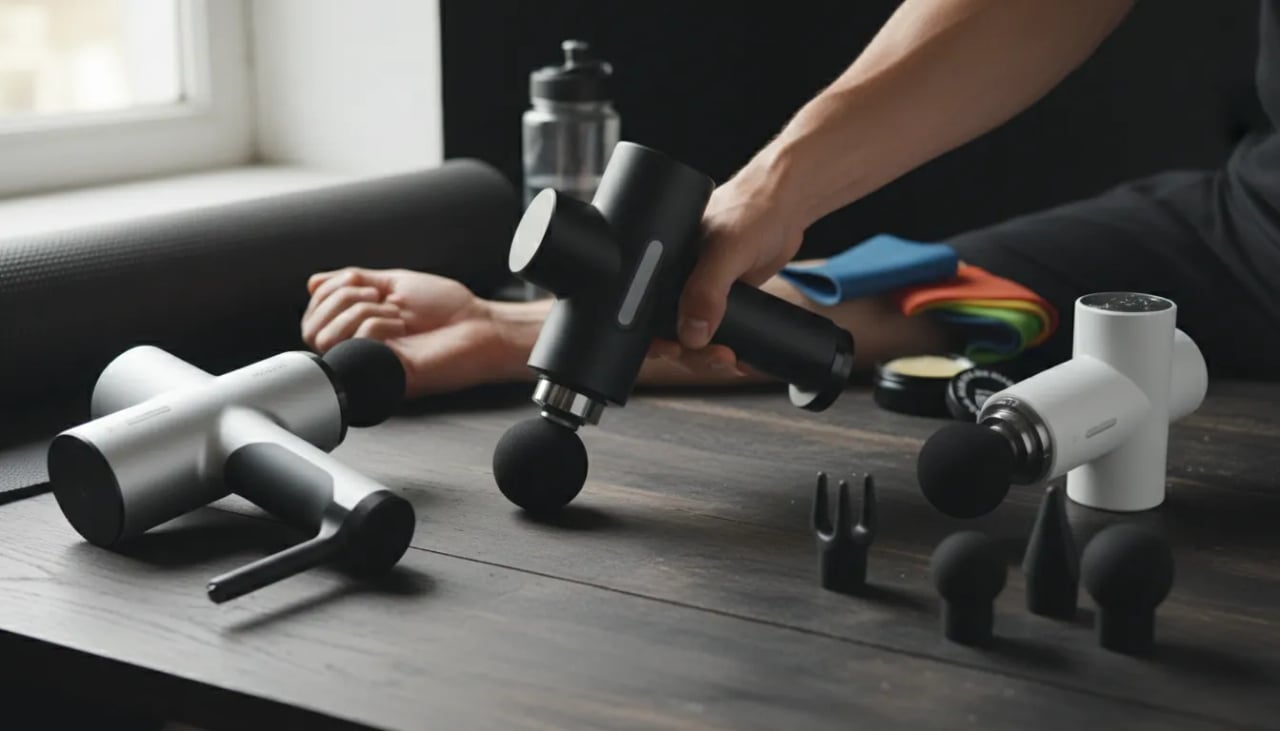
When I tested massage guns for 2026, I realized the “feel” wasn’t just about speed or power. These muscle relaxation guns use fast vibrations and percussions to ease tension, boost circulation, and help recovery—but the Interchangeable Attachments decide where that power lands and how comfortable it feels. Most good models include 4–10 heads, and I treated that range as a real buying factor, not a bonus.
Emily Carter, Licensed Massage Therapist: "Choosing the right head is like choosing the right brush: the tool changes the whole painting."
Ball Head Attachment: my default for big muscle groups
The Ball Head Attachment was my go-to on large areas like quads, hamstrings, and glutes. The broad, soft surface spreads force evenly, so I could use higher intensity without feeling “stabby.” If a massage gun only did one head well, I wanted it to be this one.
Dampener Head Design: when I want less bite
For tender spots—think post-workout soreness or areas that feel bruised—the Dampener Head Design mattered a lot. It takes the edge off the percussion, so I could still get circulation and relaxation without flinching. This head helped me use the gun more often, especially on recovery days.
Wedge Head Purpose + Fork Head Muscles: the specialized pair
The Wedge Head Purpose is all about targeting edges and flatter zones. I used it around shoulder blades and along shins, almost like a gentle scraping motion (careful near bone). The Fork Head Muscles head was best around the Achilles and along spine-adjacent muscles—never directly on the spine or other bones.
Wedge: shoulder blades, shins, IT-band edges
Fork: calves near Achilles, muscles beside the spine
Fingertip Attachment Use: precision for Trigger Point Release
For small knots, the Fingertip Attachment Use (and thumb-style heads) was the difference between “nice vibration” and real Trigger Point Release. I used low speed, short holds, and tiny movements to avoid overdoing it—especially on traps and the bottoms of the feet.
3) What specs actually predict performance (my cheat sheet)
Massage guns (or muscle relaxation guns) all promise the same thing: high-speed vibrations and percussions that push into muscle tissue to ease soreness, boost blood flow, and reduce stiffness. After testing a bunch, I stopped getting distracted by marketing and started watching a few specs that actually change how the massage feels.
Motor Strength Power + Stall Force Power (my #1 filter)
If I had to pick one spec, it’s Motor Strength Power paired with Stall Force Power. This is what keeps the head moving when I lean in on tight quads or calves. Weak motors stall under pressure, and the percussion turns into a light buzz instead of real deep tissue work. Consistent power = consistent recovery.
James Park, Editor at TechGearLab: "A powerful motor that doesn't stall beats flashy extras every time for athletes."
Amplitude + PPM (depth + speed)
Amplitude tells me how deep each hit goes, and PPM (percussions per minute) tells me how fast it hits. Together, they decide whether a gun feels like a gentle warm-up or a serious tool. In popular units, I see 11–13mm amplitude a lot, which is a sweet spot for most people. Then I use the Speed Settings Range to fine-tune—many top models stick to 5 speeds, which is usually enough when the motor is strong.
Battery Life Hours + weight (real-life usability)
Specs don’t matter if the gun dies mid-session or feels like a brick in my bag. Battery Life Hours is very model-dependent: I’ve seen 2–6+ hours across popular models depending on speed and pressure. For Portable Travel Massage, I look for compact designs that weigh <1.5 lb—and yes, some of those still hit hard if the motor is right.
Quiet Operation Performance (don’t ignore it)
A loud gun makes me use it less. I prioritize Quiet Operation Performance so I can recover while watching TV or in a hotel without feeling awkward.
Extra toys (nice, not required)
OLED force meters
Rotating arms
Heat attachments
Interchangeable heads for different body areas
I like these features, but I won’t trade away motor strength for them.
4) Quick model/spec comparison (what I tested and why)
Massage guns (or muscle relaxation guns) all promise the same thing: fast vibrations and percussions that dig into tight spots to boost circulation, reduce stiffness, and help recovery after workouts. But when I was hunting for the Best Massage Gun for 2026, I learned that the “feel” comes down to a few specs—especially Percussions Per Minute (PPM), amplitude, and how well the motor holds up under pressure.
Theragun Prime Features vs Elite vs Pro Plus (why I tested them)
I focused on Theragun’s lineup because it’s the benchmark for pro-grade build and power. The Theragun Prime stood out on paper with 16mm amplitude, 1,750–2,400 PPM, and up to 30 lbs of force. That combo is a big reason it’s often recommended as “best overall.” Elite and Pro Plus push the premium angle with stronger motors and extra polish, but I wanted to see if those upgrades changed real recovery—not just the price tag.
Budget Massage Guns: Renpho and Opove M3 Pro (why they made my list)
I also tested value picks because Budget Massage Guns have improved a lot. Models like Renpho and the Opove M3 Pro typically land around $70–$130 with 5 speeds and 5–6 heads, which covers most body areas without overthinking it.
Mark Rivera, Fitness Reviewer: "Value models have closed the gap—you're not paying as much for decent amplitude and head variety anymore."
What I measured (beyond the spec sheet)
Feel on muscle (deep thump vs surface buzz)
Quiet operation at mid and high speeds
Stall under pressure (does it bog down?)
Battery drain over a 30-minute session (real-world use)
Price Comparison Models: why a table helps
PPM across models usually spans 750–3,200, while battery life ranges roughly 2–6+ hours. A table makes it easy to compare what matters—plus note extras like head count and possible FSA/HSA eligibility.
Model | Amplitude | PPM range | Battery | Price | Heads |
|---|---|---|---|---|---|
Theragun Prime | 16mm | 1,750–2,400 | 2–6+ hrs | Premium | Varies |
Renpho / Opove M3 Pro | ~11–13mm (common) | 750–3,200 | 2–6+ hrs | $70–$130 | 5–6 |
One surprise: premium add-ons like OLED screens or heat can be nice, but they don’t always improve raw recovery outcomes as much as solid amplitude and a motor that won’t stall.
5) My imperfect field test (porch experiment and what surprised me)
My porch set-up for Muscle Soreness Relief
I didn’t run a lab test—I ran a porch test. Over multiple sessions across weeks, I used three massage guns on different days: one premium, one mid-range, and one Beginners Budget Option. Each session was timed (about 8–10 minutes per area), and I wrote down two things right after: how sore I felt and how loose the muscle seemed. Since these muscle relaxation guns use high-speed vibrations and percussions to improve blood circulation, reduce stiffness, and support Muscle Recovery, I focused on what I could actually feel, not what the box promised.
Dr. Lena Ortiz, Physical Therapist: "Practical testing—how a tool performs in everyday use—often reveals more than spec sheets."
What I measured: Quiet Operation Performance, power, and battery
I kept it simple: perceived deep-tissue effectiveness, rough quietness, and battery drain in short trials. The budget model showed noticeable battery drain with heavy use, while the premium and mid-range held up better. For Portable Travel Massage, I also tried a smaller unit under 1.5 lb, and it still delivered adequate power for quick post-workout touch-ups.
What I tracked | What I noticed |
|---|---|
Noise | Quiet didn’t always mean weak |
Deep-knot relief | Amplitude mattered most |
Battery | Budget drained faster under heavy use |
Pressing into knots | Stall force separated winners from “okay” |
Surprises: amplitude beat PPM, and quiet could still hit hard
The biggest surprise was that amplitude (how far the head moves) mattered more than raw PPM for deep-knot relief. One quieter model had strong Quiet Operation Performance and still “punched” into tight spots. Meanwhile, the budget gun was fine for casual use, but when I leaned in, the motor could falter—stall force really matters when you press into knots.
Real-world tip: heads and speeds that actually worked
Warm-up: lower speeds + larger ball head for general circulation and loosening.
Trigger points: higher amplitude + firmer heads (bullet/flat) for stubborn spots.
Shoulders: my neighbor swore by the wedge head for guitar-theory-induced tension. I didn’t judge.
6) Buying guide: pick the right gun for your life (quick checklist)
When I’m doing Massage Gun Selection, I start with the basics: these muscle relaxation guns use fast vibration and percussion to push into muscle tissue, boost circulation, ease stiffness, and help recovery after workouts. The Best Massage Gun for you is the one you’ll actually use—because settings and attachments only matter if it fits your routine.
Laura Chen, Sports Recovery Coach: "Match the tool to your routine; a high-end gun won’t help if you only use it once a month."
Quick checklist (what I check first)
Power: look for meaningful amplitude and solid stall force (even travel models can deliver).
Speed control: multiple intensity levels (I like 4–5+ speeds for dialing it in).
Attachments: typical kits include 4–10 heads for calves, back, and smaller spots.
Comfort: weight, grip, and noise—because you’ll hold it for minutes at a time.
Professional-grade performance (my “go big” picks)
If you want consistent, pro-level output, I point people to Theragun. The Theragun Elite and Prime Plus are my best overall options because they bring high amplitude and strong force that doesn’t bog down on dense muscles. Some premium models also add Bluetooth app control, plus extras like a Force Meter OLED or rotating arms if you want all the bells and whistles.
Budget Massage Guns (best value for casual users)
If you’re shopping for Budget Massage Guns, I’ve had great results recommending Renpho and the Opove M3 Pro. In the $70–$130 range, you can still get 5 speeds and multiple heads—perfect as a Beginners Budget Option for post-gym soreness or desk-tight shoulders.
Portable Travel Massage (what I won’t compromise on)
For Portable Travel Massage, I aim for guns under 1.5 lb, with a carry-on-friendly battery and enough stall force to work through quads and calves. Small is fine—weak isn’t.
Extras to budget for (Buying Guide Massage)
FSA/HSA eligibility (can change the real price fast)
Heat therapy attachments if you love warming up tight areas
Price comparison across models and bundles (heads + case add value)
7) Wild cards: creative analogies and hypothetical picks
Why I use weird comparisons to judge Percussion Massage Guns
When I tested muscle relaxation guns (massage guns), the specs only started to matter once I could feel them. These tools use high-speed vibrations and percussions to push into muscle tissue, helping blood flow, easing stiffness, and supporting recovery after workouts. But “amplitude” and “PPM” can sound like robot talk, so I translate them into something I can remember.
The drummer test: amplitude and PPM as a groove
I think of a massage gun like a drummer. Amplitude is the stick length—how deep the hit goes. PPM is the tempo—how fast the hits land. Change either one and the whole “groove” changes on your body. A short stick at a fast tempo can feel buzzy and surface-level. A longer stick at a steady tempo can feel like it’s getting into the tight spot without making me tense up.
Dr. Aaron Feldman, Rehabilitation Scientist: "Metaphors cut through jargon—think amplitude as the punch, PPM as the rhythm."
I like expert anchors like that, but I still treat them as a starting point. My rule: listen to the quote, then test on your own body for 30–60 seconds and see how your muscles react.
My $80, one-month 10K scenario (the “good enough” pick)
If I only had $80 and one month to train for a 10K, I’d grab a Renpho-style budget gun with a few intensity levels and basic heads. I’d use it for quick daily warm-ups on calves, quads, and glutes, then lean on foam rolling for slower, deeper work. That combo gives me practical Muscle Recovery Massage without pretending a cheap device can do everything.
Quick creative aside: your muscle is a sponge
Sometimes I picture my sore calf as a sponge. Each percussion “squeeze” pushes fluid in and out, nudging circulation along. It’s not magic—it’s just a simple way to remember why certain Massage Gun Features (depth, speed, and head shape) can make a real difference. And that’s how I ended up picking winners: a little science, a little story, and a lot of hands-on testing.